What Axo Longevity data reveals about hidden health risks
AUTHOR
AL
Axo Longevity
REVIEWED BY
AL
Axo Longevity
UPDATED
June 26, 2026
Share
This report draws on anonymised, aggregated Axo data. No individual is identifiable, and figures are reported only at the level of the whole group.
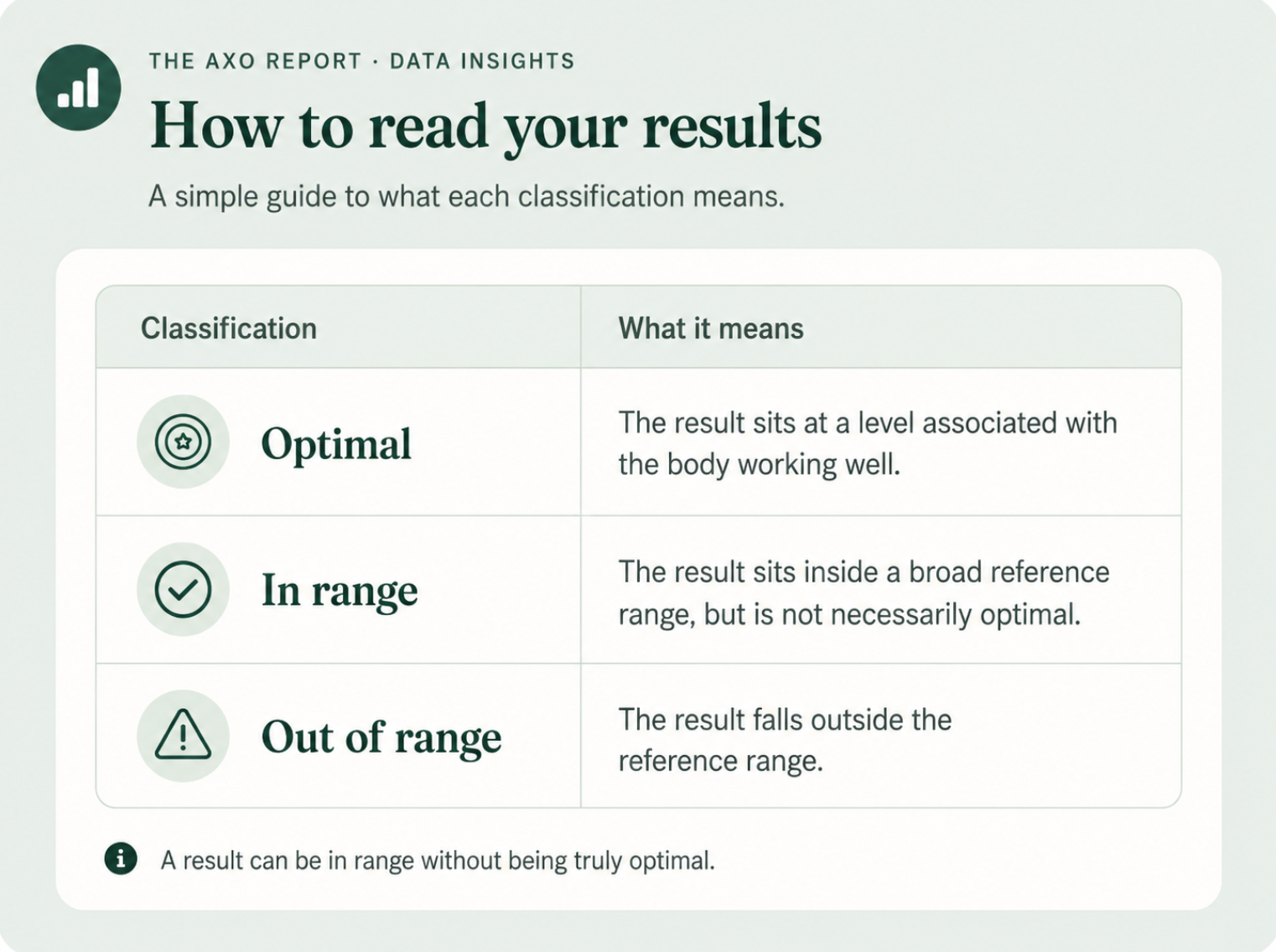
Three classifications are used throughout, taken directly from Axo's clinical reference ranges:
Optimal: the result sits at the level associated with the body working well, not merely the absence of disease.
In range: the result falls inside the wide reference band a standard test uses to rule out disease, but is not necessarily optimal.
Out of range: the result falls outside that reference band.
Two summary measures appear in places.
Health score is the share of markers that are optimal or in range.
Optimal rate is the share at the optimal level only. Every percentage is calculated among the people actually tested for that marker, not the whole group, and figures are rounded.
Let’s get into it.
Across the people who have tested with Axo, the single clearest finding is this: not one came back fully optimal. On average, only about 54% of measured markers reached a truly optimal level, and the typical person carried roughly nine or ten markers out of range, almost always without symptoms to point to them.
This holds in a population that is already proactive about health, the kind that invests in deep testing. If optimal is rare here, it is likely rarer still in the wider public.
Key takeaways
Optimal is the exception, not the rule. The average optimal rate sits near 54%, and it stays in a narrow band regardless of how many markers are measured. This points to a genuine optimisation ceiling rather than a testing artefact.
Most risk is silent. The most common patterns, fatigue, cognitive, cardiovascular and hormonal, are driven by markers that produce no obvious day-to-day signal.
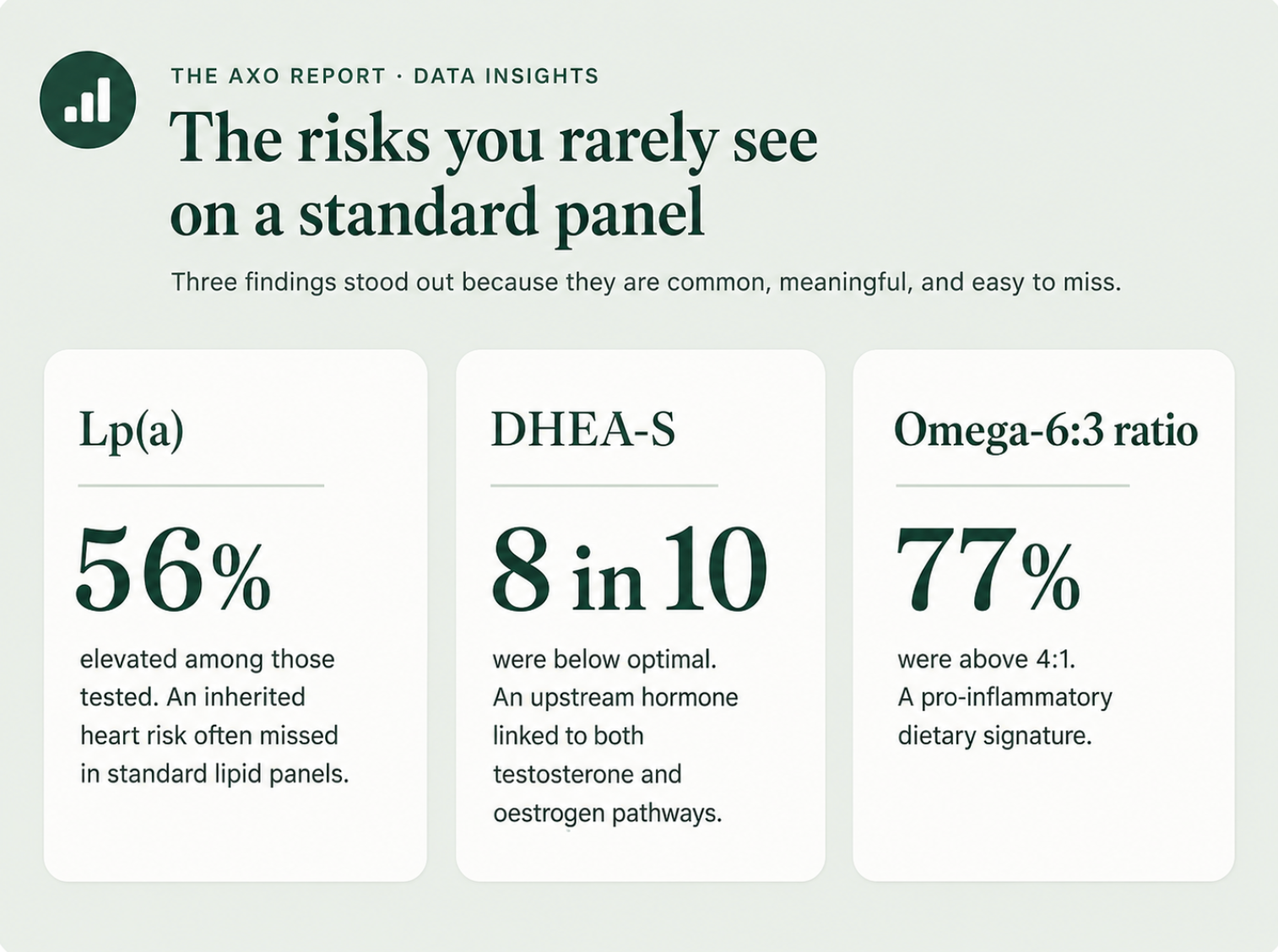
A few risks are both common and invisible on a standard test. Elevated Lp(a), below-optimal DHEA-S and a pro-inflammatory omega ratio stand out, none of which appear on a routine panel.
"In range" is doing a lot of quiet work. Overall health scores look reassuring (markers optimal or in range sit around 86%), but that figure masks how few results are actually optimal.