






































TL;DR
- GLP-1 medicines such as Wegovy, Ozempic and Mounjaro change more than your weight: several blood results move as well.
- Many results improve: in the main Wegovy trial, CRP fell to less than half its starting level, and HbA1c, triglycerides and blood pressure all came down.
- Some results need watching, because eating less can mean taking in less vitamin D, iron and B vitamins, and part of the weight lost is lean mass.
- A baseline blood test before you start gives every later result something to be compared with.
- Retesting while you take the medicine shows which results are improving and which need attention, so you can act early.
Most people on a GLP-1 track one number: the one on the scale. It is easy to see, it moves quickly, and it is usually the reason they started. But the medicine is working on far more than weight, and much of that work shows up only in a blood test.
Some of those changes are very good news. Others are side effects of eating much less food, and they are easy to miss because they do not show on the scale. This guide explains what a GLP-1 does, which blood results usually improve, which ones are worth watching, and why a test before you start makes every later result easier to read.
What is a GLP-1 and how does it work?
GLP-1 is a hormone your gut releases after you eat. It helps your body release insulin when blood sugar rises, makes you feel full sooner and slows how quickly food leaves your stomach. GLP-1 medicines copy this hormone for much longer than a meal does, which is why appetite falls and weight comes down.
The names people know are brand names. Wegovy and Ozempic both contain semaglutide, at a higher dose in Wegovy, which is used for weight management, and a lower one in Ozempic, which is used for type 2 diabetes. Mounjaro contains tirzepatide, which acts on GLP-1 and on a second gut hormone as well.
Think of a GLP-1 as turning down the appetite dial for the whole body. Fewer calories come in, and that is the point. But food brings more than calories. When portions shrink, the protein and nutrients in them shrink too, unless you plan for it. That one idea explains most of what changes in your blood.
Does a GLP-1 affect your blood test results?
Yes. A GLP-1 changes several common blood results, and mostly in a good direction. Blood sugar, inflammation and the fats in your blood usually improve as weight comes down. A few results can move the wrong way, mainly the vitamins and minerals that come from food.
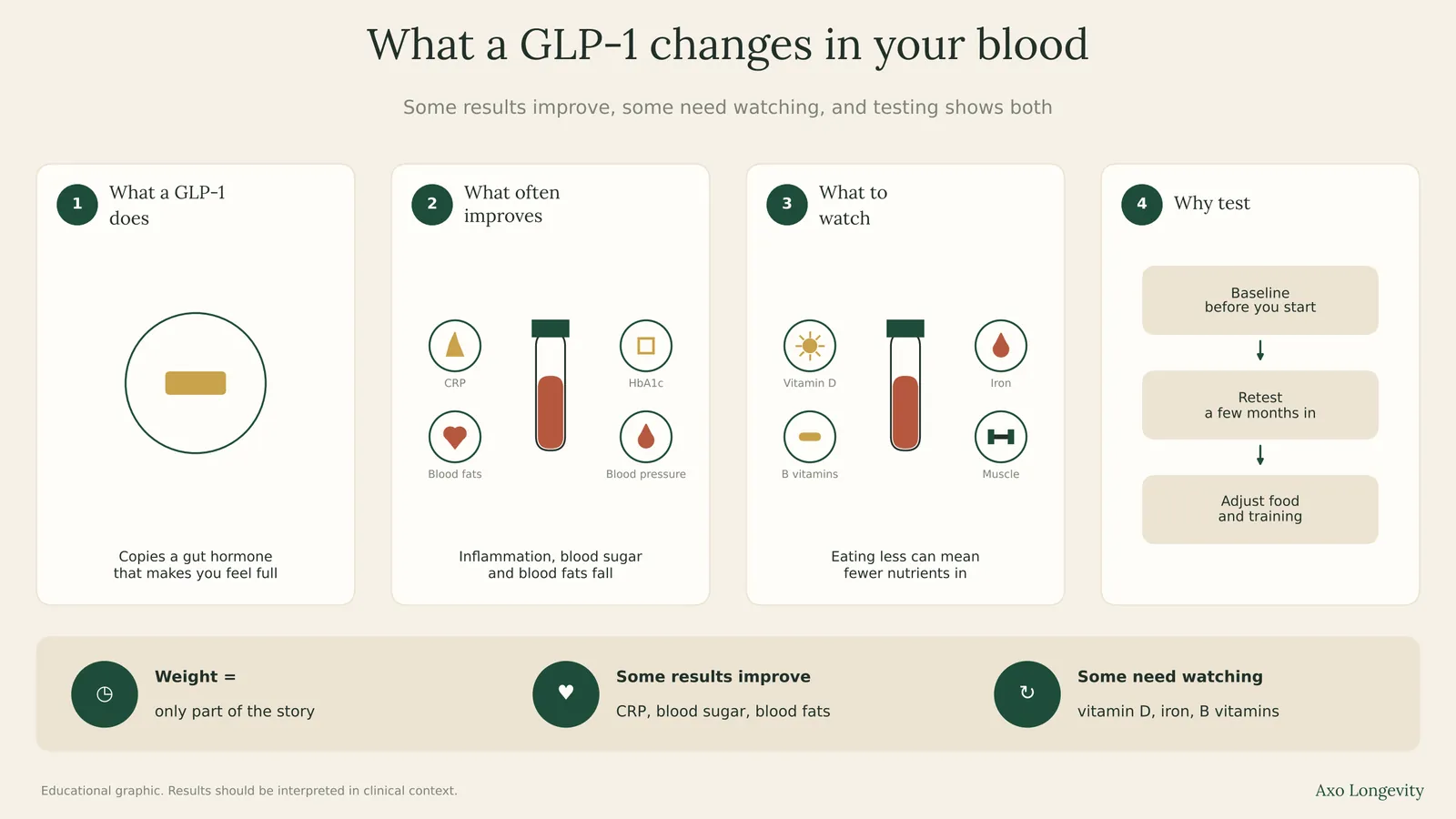
The graphic above sums it up. The medicine turns appetite down, several results improve, a few need watching, and a test before you start lets you tell which is which.
| Results that usually improve | Results worth watching | |
|---|---|---|
| Examples | CRP, HbA1c, triglycerides, blood pressure | Vitamin D, iron, B vitamins, lean mass |
| Why they move | Weight loss and the medicine itself | Eating less food overall |
| What to do | Track them to see the benefit | Test early and adjust your diet |
| What they show | How your metabolism is responding | Whether your body is getting enough |
Which blood results usually improve on a GLP-1?
Inflammation, blood sugar and blood fats usually improve. In the main trial of semaglutide at the Wegovy dose, people lost 14.9% of their body weight over 68 weeks, and CRP, HbA1c, triglycerides and blood pressure all fell compared with placebo.
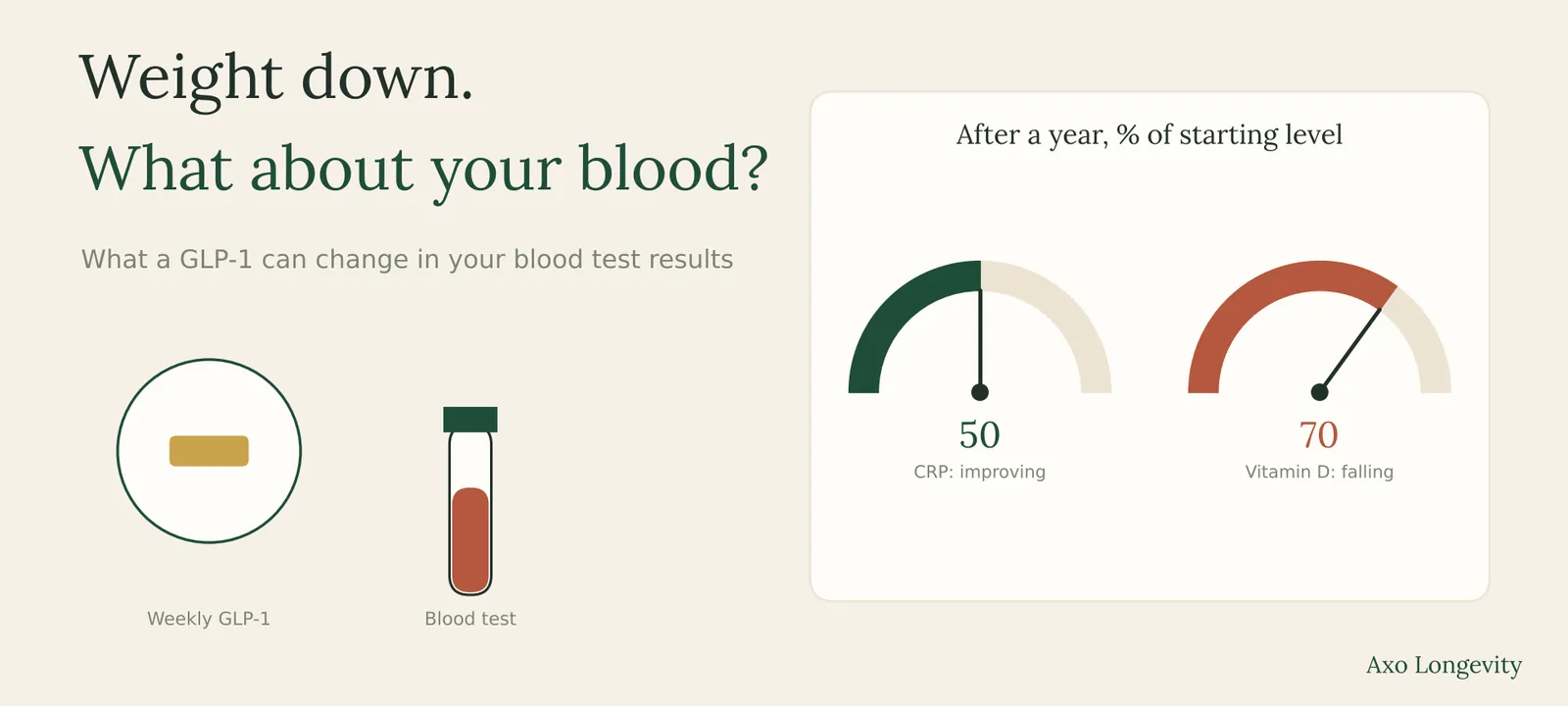
In that trial, known as STEP 1, people taking a placebo lost 2.4% of their weight over the same time. CRP, a protein that rises with low-level inflammation, fell to 0.45 times its starting level on semaglutide, against 0.84 times on placebo. In other words, it more than halved. HbA1c fell by 0.45 percentage points, triglycerides fell by about 22% and systolic blood pressure fell by about 6 mmHg.
The chart puts the two biggest changes side by side. These are average changes in a large trial, so your own numbers will not match them exactly. They do show why weight is only part of the story. Axo Longevity reports CRP, HbA1c and blood fats side by side for exactly this reason: two people can lose the same weight while their blood tells two different stories.
→ Read what each number on a lipid panel means
What should you watch while taking a GLP-1?
Watch the nutrients that come from food and the muscle you carry. When you eat much less, vitamin D and iron can fall along with some B vitamins, and part of the weight you lose is lean mass, which includes muscle. Neither shows up on the scale.
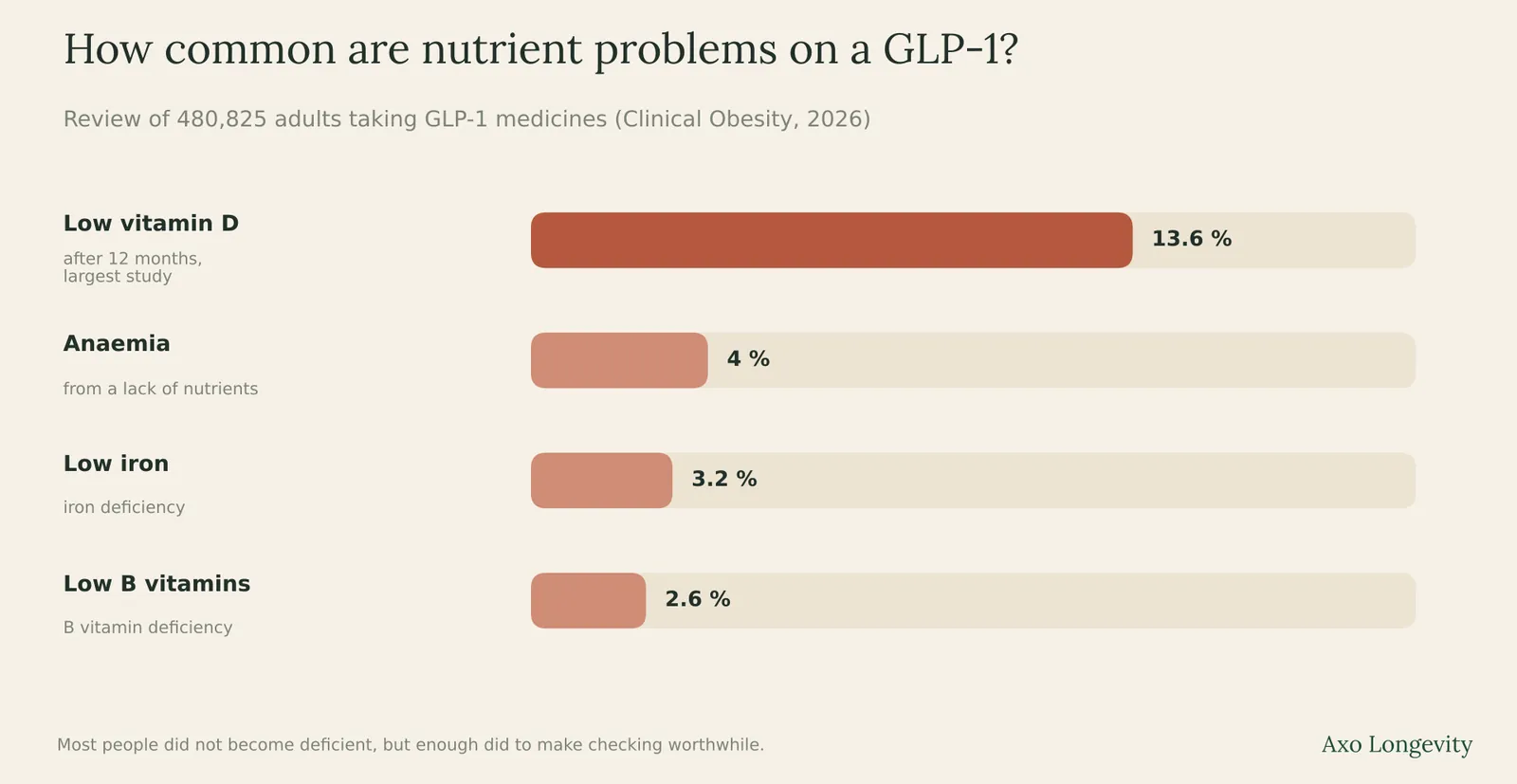
A 2026 review covering 480,825 people taking GLP-1 medicines found that 13.6% had a vitamin D deficiency by 12 months. Anaemia appeared in 4%, iron deficiency in 3.2% and a B vitamin deficiency in 2.6%. Most people stayed clear of all of them. But a vitamin D deficiency in more than one person in eight is common enough to check for.
Lean mass is the second thing to watch. In a body scan study within STEP 1, total lean mass fell by 9.7%. Fat fell even faster, so lean mass made up a larger share of the body afterwards, up by 3.0 percentage points. Your body ends up with relatively more muscle and less fat. Some muscle still went with the fat, though, and keeping it matters for strength as you age.
As the graphic shows, the useful checks fall into six groups:
- Blood sugar: HbA1c, your average blood sugar over the last two to three months, and fasting glucose
- Inflammation: CRP
- Blood fats: triglycerides, LDL cholesterol and HDL cholesterol
- Vitamins: vitamin D and B vitamins such as B12 and folate
- Iron: ferritin, your iron store, and haemoglobin, which shows anaemia
- Hormones: testosterone, for men
Why test before you start a GLP-1?
Because a result only means something next to an earlier one. A baseline test before your first dose shows where each value started, so a later result can show whether it really improved, held steady or drifted down. Without it, a low vitamin D after six months could be new or could have been there all along.
A baseline may also matter for how well the medicine works. In a study published in October 2026, people with higher vitamin D before starting semaglutide had a larger fall in BMI and HbA1c after 12 months. The study observed people rather than testing vitamin D as a treatment, so it cannot show that raising vitamin D improves the result. It does give one more reason to know your level before you start.
What can your results look like after a year on a GLP-1?
Most of the improvements and the nutrient drift happen at the same time, so a set of results can look better and worse at once.
Take Person A (an illustrative example, not a real person), using the average changes from STEP 1 for the results that improve. Before starting, Person A weighs 100 kg, with a CRP of 4.0 mg/L, an HbA1c of 5.9% and triglycerides of 2.0 mmol/L. After a year, they weigh 85.1 kg, their CRP is 1.8 mg/L, their HbA1c is 5.45% and their triglycerides are 1.56 mmol/L. On those numbers alone, the year has gone very well.
Now add the two results that come from food. Person A's vitamin D has gone from 55 nmol/L to 42 nmol/L, and their ferritin from 80 µg/L to 55 µg/L. These two figures are chosen to show the pattern to look for, not taken from a trial average. Neither is a crisis on its own, but both are heading the wrong way, and both are easier to correct early than late.
The chart shows why one test is not enough. Every bar except vitamin D and ferritin is good news, and the scale would only ever have shown the first one.
Before you test: test at the same time of day each time and with the same preparation, and fast if your lab asks you to, so glucose and triglycerides are comparable. If you had a bout of sickness or ate very little in the days before, mention it, because it can shift some results.
Do GLP-1s affect hormones like testosterone?
In men with low testosterone linked to obesity, GLP-1 medicines appear to raise it rather than lower it. The research is early, and the changes are modest.
Research presented at the Endocrine Society's 2026 meeting found that GLP-1 medicines did not harm male hormones, and may improve testosterone in men whose low levels were linked to obesity. In a study of 1,629 men presented at a 2026 urology meeting, total and free testosterone rose on GLP-1 medicines, and part of the rise seemed to go beyond the effect of weight loss alone. These are conference findings, not yet full trials, so they are a reason to include testosterone in a baseline for men, not a reason to start a GLP-1.
→ See the signs of hormone imbalance in men
How do you protect muscle and nutrients on a GLP-1?
By making the smaller amount you eat count. Protein and strength training help hold on to muscle, and food rich in vitamins and minerals helps cover what smaller portions leave out.
In practice:
- include a source of protein at every meal, even when portions are small
- do regular strength training, so your muscles have a reason to stay
- choose foods that carry iron and vitamins in small portions, such as oily fish, eggs, pulses and leafy greens
- retest the results that were low or falling, rather than guessing
The honest limit is that none of the studies above tested a specific diet or exercise plan alongside a GLP-1, so nobody can yet say which approach works best. Your Axo Longevity personalised plan starts from your own results, so it can focus on the nutrients that are actually low for you. Never change the dose of your medicine or start high-dose supplements without speaking to your prescriber first.
How often should you check your blood on a GLP-1?
Start with a baseline before your first dose, then retest the same lab tests while you are taking the medicine, at the same time of day and with the same preparation. That shows which results are improving and which need attention. Our guide to measuring inflammation explains what else can move CRP between tests.
Axo Longevity measures 100+ lab tests across 36+ areas of your health. Around six months later, a follow-up repeats 50+ of those lab tests, so you can see the change for yourself.
→ Your Axo Health Score
→ Results compared to optimal ranges
→ Your personalised plan
→ A follow-up test to track the change
What else do people ask about GLP-1s and blood tests?
Can Ozempic change your cholesterol results?
It can. Semaglutide, the medicine in Ozempic and Wegovy, lowered triglycerides by about 22% in the STEP 1 trial, which used the Wegovy dose, and blood fats improved overall.
Can a GLP-1 cause low vitamin D?
Low vitamin D is common in people taking GLP-1 medicines. In a 2026 review of 480,825 people, 13.6% had a vitamin D deficiency by 12 months, so it is worth testing before you start and again while you take the medicine.
Do you need to fast for a blood test on a GLP-1?
Only if your lab asks you to. Fasting matters for glucose and for some cholesterol tests. Follow the instructions for your own test, and keep your preparation the same each time so the results stay comparable. Our guide to which blood tests need fasting explains why.
Axo Longevity provides health information, not medical advice. Speak to a healthcare professional about your results.
Where does this information come from?
- Wilding, J. P. H., et al. (2021). Once-weekly semaglutide in adults with overweight or obesity (STEP 1). New England Journal of Medicine, 384, 989-1002. https://pmc.ncbi.nlm.nih.gov/articles/PMC8089593
- ClinicalTrials.gov. STEP 1 results, NCT03548935: change in hsCRP at week 68. https://clinicaltrials.gov/study/NCT03548935
- Summary of STEP trial outcomes (table 1): HbA1c, triglycerides and systolic blood pressure in STEP 1. https://pmc.ncbi.nlm.nih.gov/articles/PMC9209591/table/T1
- STEP 1 body composition substudy (DXA): change in total lean mass and lean proportion at week 68. https://pmc.ncbi.nlm.nih.gov/articles/PMC8089287
- Harvard Health Publishing. (2026). Study: taking GLP-1 drugs may increase risk of key nutrient deficiencies (on a review in Clinical Obesity). https://www.health.harvard.edu/diet-and-nutrition/study-taking-glp-1-drugs-may-increase-risk-of-key-nutrient-deficiencies
- Frontiers in Nutrition. (2026). Baseline vitamin D and response to semaglutide at 12 months. https://www.frontiersin.org/journals/nutrition/articles/10.3389/fnut.2026.1833045/full
- Endocrine Society. (2026). ENDO 2026 press release on GLP-1 medicines and male hormones. https://www.endocrine.org/news-and-advocacy/news-room/2026/natesh-press-release-endo-2026
- Medscape. (2026). GLP-1 RAs may independently boost testosterone levels (AUA 2026). https://www.medscape.com/viewarticle/glp-1-ras-may-independently-boost-testosterone-levels-2026a1000fxi