







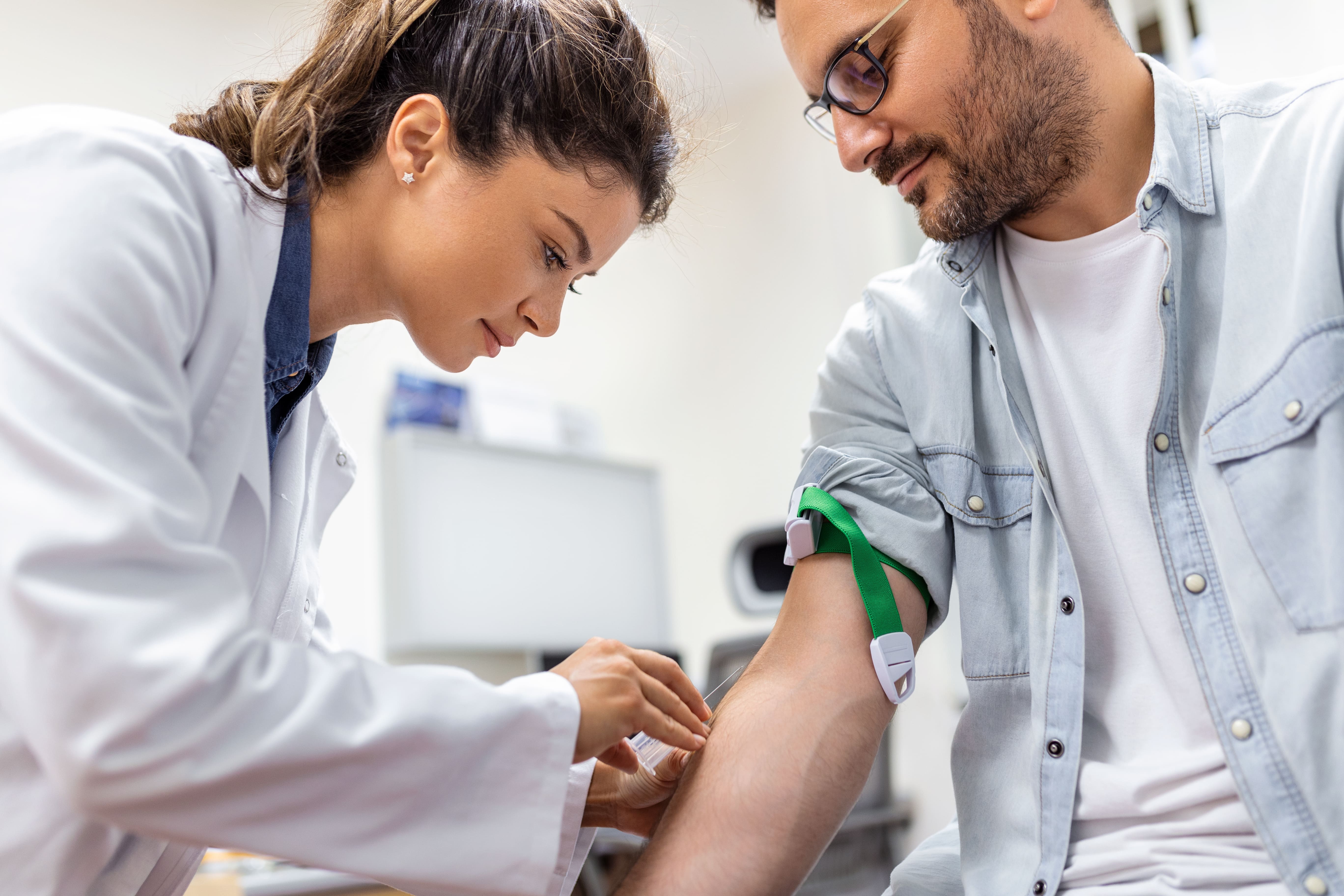
Why and which blood tests need fasting?
October 29, 2026
TL;DR
- Only a few common blood tests need fasting: a fasting glucose test and, under UK guidance, a morning testosterone test are the main ones.
- Most cholesterol tests do not: after a normal meal, LDL cholesterol falls by about 0.2 mmol/L and triglycerides rise by about 0.3 mmol/L at most, according to a 2016 European consensus.
- HbA1c, ApoB, Lp(a), HDL cholesterol and ferritin are barely touched by food, so a non-fasting sample is fine for them.
- Thyroid and iron results shift with meals or the time of day, so testing the same way each time matters more than fasting itself.
- When you do fast, water is fine; follow your own lab's instructions and never stop a medicine without asking your doctor first.
Most people have been told at some point to skip breakfast before a blood test. Some are told 8 hours, others 12 to 14, and plenty are told nothing at all. Then they search the question and find the advice disagrees, sometimes between two NHS pages.
The reason is that food changes some blood results a lot, some a little and some not at all. Once you know which is which, the instructions start to make sense, and you can make sure every result you get is one you can compare with the next. This guide goes through the common tests one by one, explains why food matters for some and not others, and shows what a breakfast can do to a real set of numbers.
What does fasting before a blood test mean?
Fasting before a blood test means having nothing to eat or drink except water for a set time before your sample is taken, usually 8 to 12 hours. It is done so that a recent meal does not change the result. For most people that means eating dinner as normal, then skipping breakfast and having the test in the morning.
Fasting is stricter than many people expect. One NHS trust's fasting guidance asks people to drink only water on the morning of the test, and to avoid tea, coffee (including black coffee), fizzy drinks, diet drinks, chewing gum, smoking and vaping. The same guidance says not to change your medicines unless your doctor tells you to, and asks people with diabetes to speak to their doctor before fasting for any test.
Why does food change some blood results and not others?
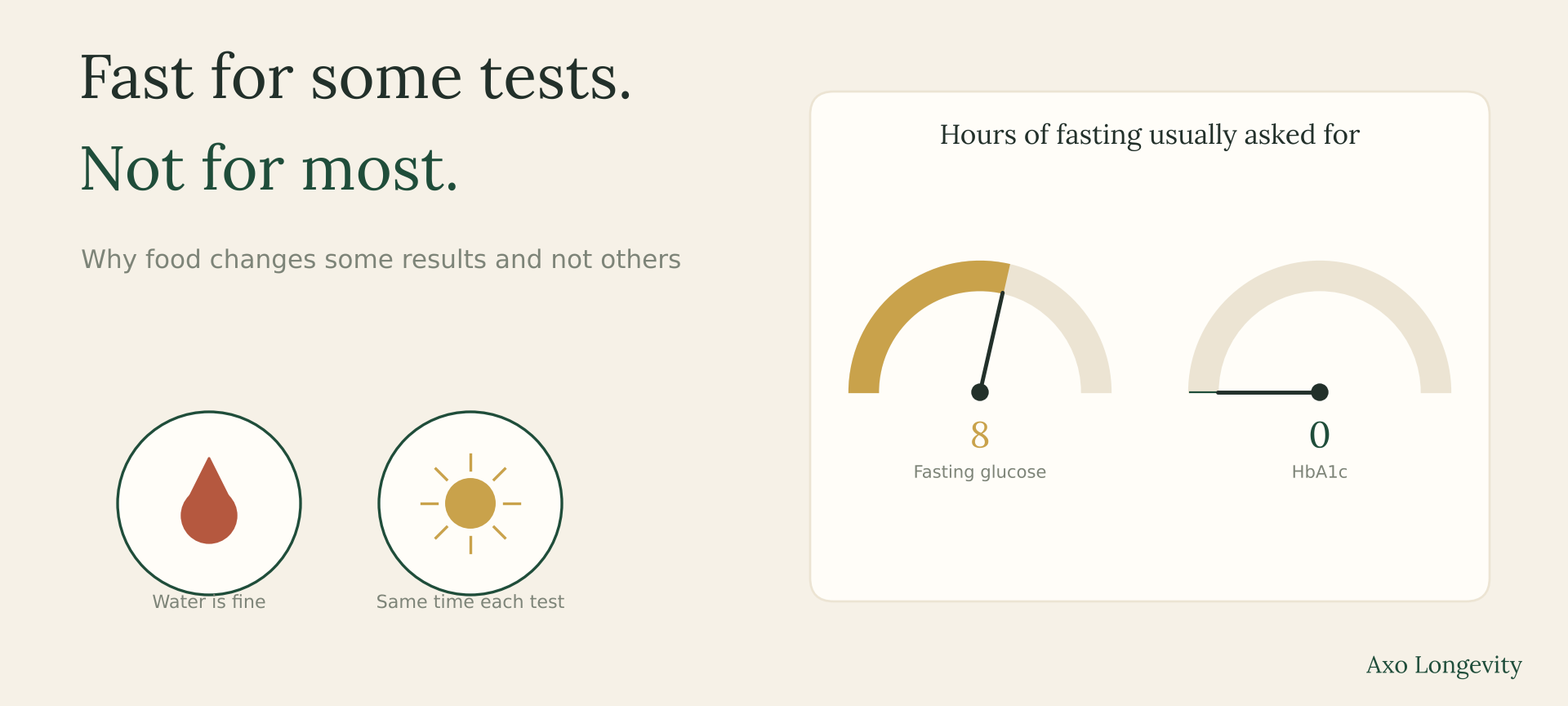
Food changes the results that respond to a meal within hours, such as blood sugar and the fats called triglycerides, while results that build up over weeks or months barely move.
Think of a blood test as a photograph of a busy road. A meal is rush hour. Take the picture at 8.30am and the road looks crowded, but only for a while: a few hours later it is back to normal. Some blood values behave like that traffic. Others are more like the road itself, which looks the same whether the picture is taken at rush hour or at dawn.
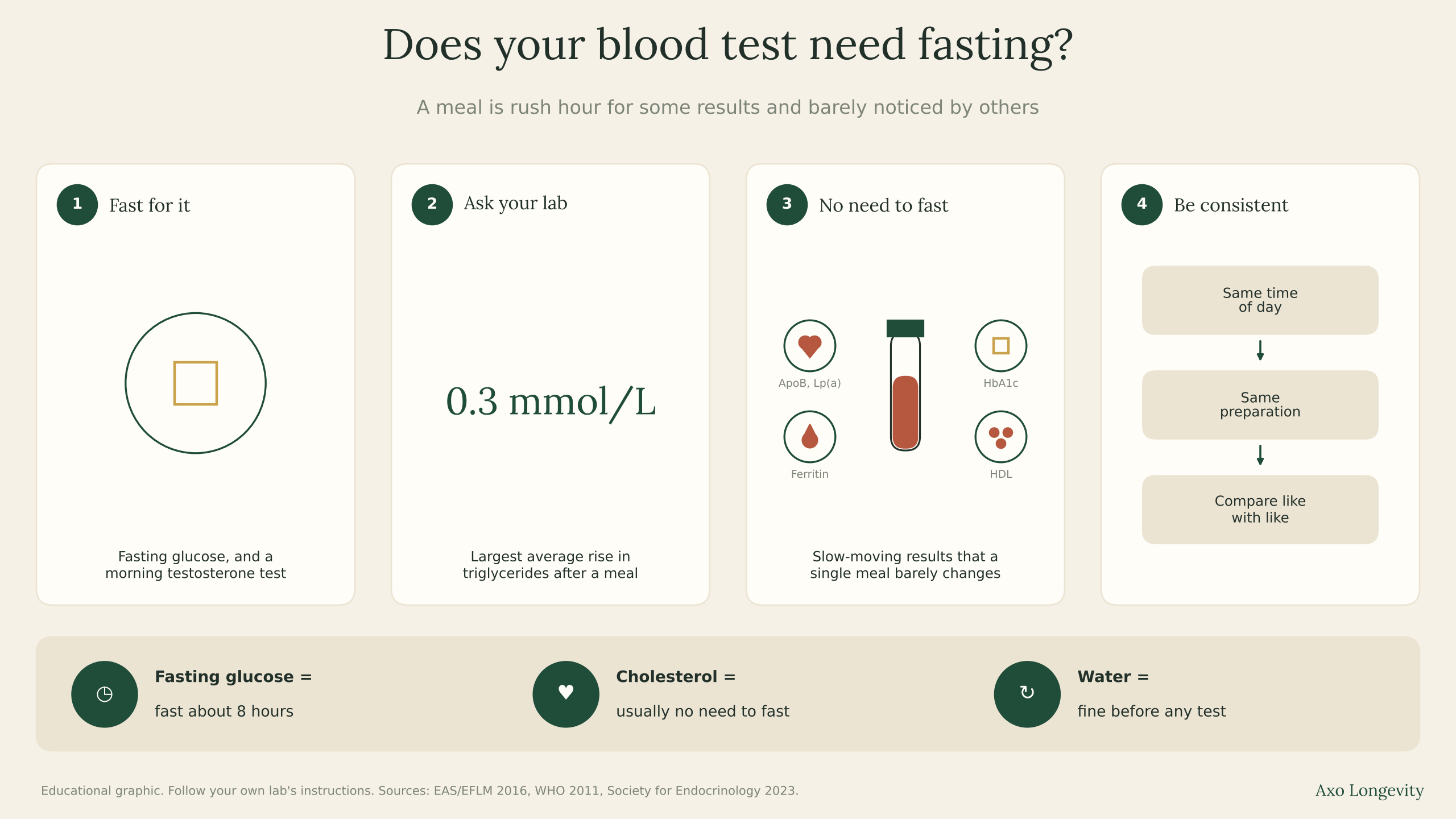
The graphic above sums it up. A few tests need you to fast, a few are affected by the time of day, and many of the most useful ones can be taken at any time. What matters for all of them is testing the same way each time.
Which blood tests need fasting?
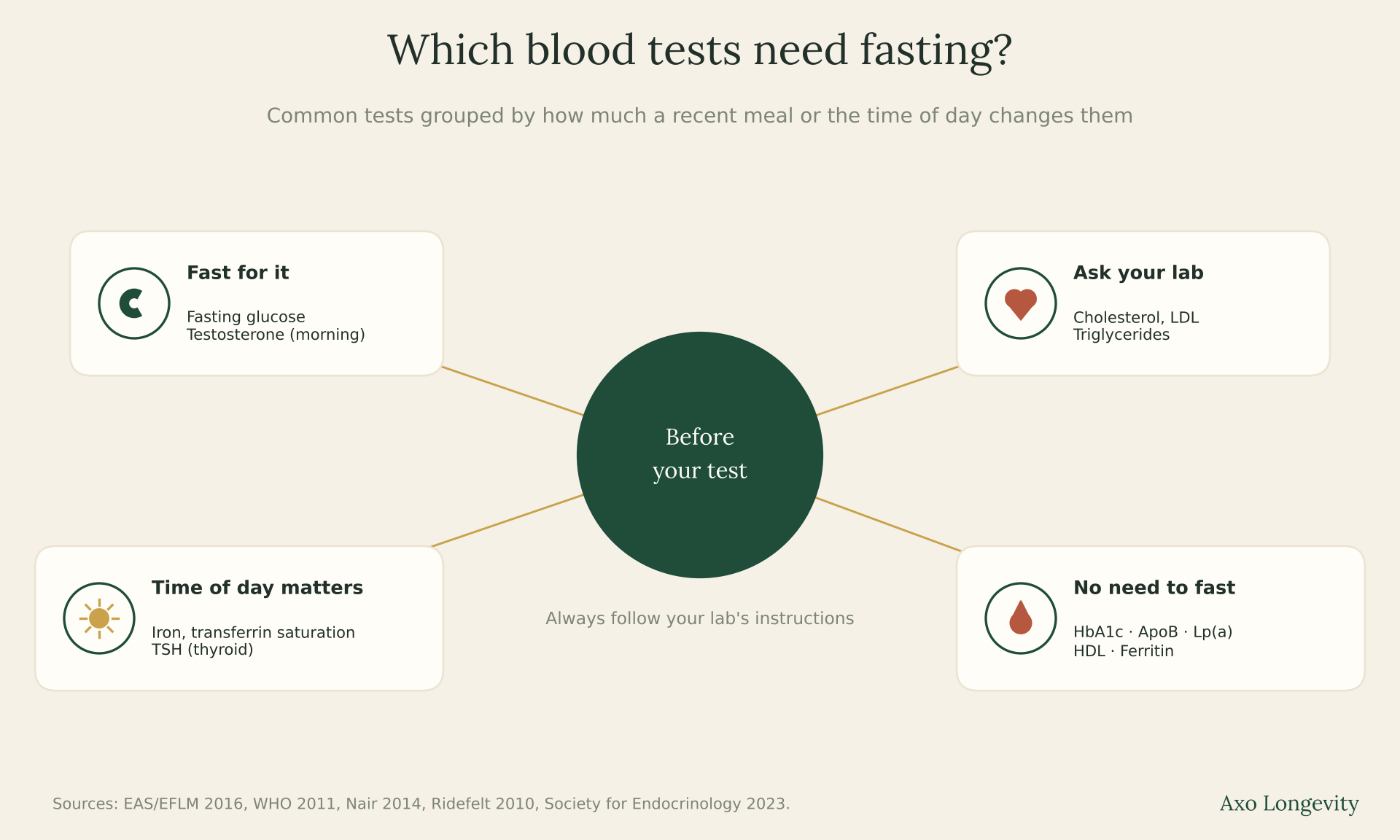
The two common blood tests that clearly need fasting are a fasting glucose test and, under UK guidance, a morning testosterone test. Some labs also ask you to fast before a cholesterol test, a fasting insulin test or an iron test, so always check the instructions that come with your form or kit.
As the graphic shows, the common tests fall into four groups:
- Fast for it: fasting glucose, which is designed to show your blood sugar without a recent meal, and testosterone, which UK guidance from the Society for Endocrinology says should be measured in the morning while fasting, because levels fall after meals.
- Ask your lab: cholesterol, LDL cholesterol and triglycerides. Many labs no longer require fasting; some still do.
- Time of day matters: iron, transferrin saturation and TSH, the main thyroid test.
- No need to fast: HbA1c, ApoB, Lp(a), HDL cholesterol and ferritin.
Preparation is part of the result. That is why Axo Longevity compares your results to optimal ranges, not only standard ranges: a small shift only means something if the conditions behind it were the same each time.
Do you need to fast for a cholesterol test?
Usually not. NICE, which sets health guidance in England, does not require a fasting sample for a cholesterol test, and European experts recommend non-fasting tests as the routine. Some labs still ask for 12 to 14 hours of fasting, so follow the instructions you are given.
The reason is that a normal meal changes cholesterol results very little. A 2016 joint statement from European heart and laboratory experts found that, 1 to 6 hours after a usual meal, the largest average changes were a rise of 0.3 mmol/L in triglycerides and a fall of 0.2 mmol/L in total and LDL cholesterol. They judged those changes too small to matter for most decisions, and recommended non-fasting tests to make testing easier.
There is one honest catch. In many labs, LDL cholesterol is calculated rather than measured directly, and the calculation uses your triglycerides. When triglycerides are high, a non-fasting LDL can read lower than it should. That is why the same statement suggests a fasting test when non-fasting triglycerides are above 5 mmol/L, and why some UK lab specialists still prefer a fasting sample for a first baseline.
→ Read what each number on a lipid panel means
Does ApoB, Lp(a) or HbA1c need fasting?
No. ApoB, Lp(a) and HDL cholesterol are not affected by a normal meal, and HbA1c can be measured at any time of day without any preparation.
ApoB counts the particles that carry cholesterol around your blood, and Lp(a) is one particular type of those particles. The 2016 European statement found that neither changes with fasting or eating. HbA1c is different again: it shows your average blood sugar over the last 2 to 3 months, so one breakfast makes no difference. The World Health Organization notes that HbA1c does not need fasting and avoids the day-to-day swings of a single glucose reading, although some anaemias and differences in red blood cells can affect it.
Does a thyroid test need fasting?
Fasting is optional for a thyroid test. TSH, the main thyroid result, can read lower after food, so it helps to test the same way each time. Free T4, the thyroid hormone itself, seems to stay steady.
In a small study of 57 adults, TSH was measured fasting and again two hours after food. TSH fell after eating in everyone. Of 20 people whose fasting TSH was raised while their free T4 was normal, 15 had a TSH inside the reference range after a meal. That matters most when a result sits close to the line, because a borderline TSH can be the difference between being told to retest and being told all is well. It is one small study, so treat it as a reason to be consistent rather than a rule to fast: a morning fasted result and an afternoon result after lunch are a poor comparison.
Do iron and ferritin tests need fasting?
Ferritin does not need fasting. Serum iron and transferrin saturation change more with the time of day than with meals, which is why labs usually ask for a morning sample.
Ferritin is the body's iron store, and it changes slowly. In a study that tested people every few hours for a day, ferritin showed no daily rhythm and meals had almost no effect. Serum iron and transferrin saturation behaved very differently, rising and falling across the day and peaking around midday after a normal night's sleep. The study only included seven people, so treat it as a guide rather than a rule. In practice, if you are tracking iron, test at the same time of day each time.
Why can the same person get different results fasted and after breakfast?
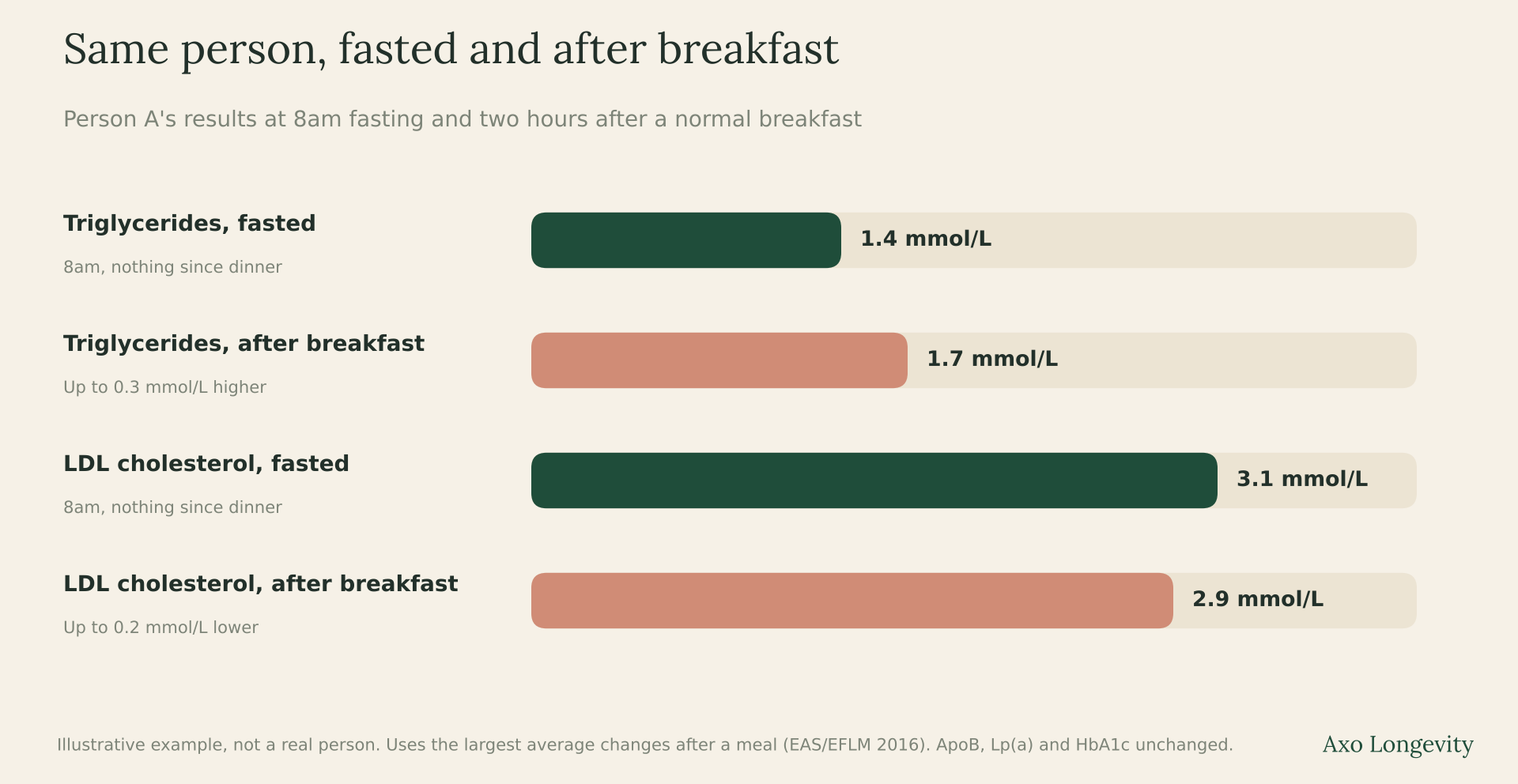
Because a meal moves the fast-moving values for a few hours, while the slow ones stay where they are.
Take Person A (an illustrative example, not a real person), using the largest average changes from the 2016 European statement. Tested fasting at 8am, Person A has triglycerides of 1.4 mmol/L and an LDL cholesterol of 3.1 mmol/L. Tested two hours after a normal breakfast, the same person could show triglycerides of up to 1.7 mmol/L and an LDL as low as 2.9 mmol/L. Their ApoB, Lp(a) and HbA1c would read exactly the same at 8am and at 10am, because a single meal does not move them.
Neither set of numbers is wrong. Both describe Person A accurately at that moment. The problem only appears when you compare a fasting result one year with a non-fasting one the next, and read the difference as real change. A 0.2 mmol/L fall in LDL could be a breakfast, not a better diet.
Before you test: follow your lab's instructions, drink water as normal, and note when you last ate. Test at the same time of day and with the same preparation each time, so Axo Longevity can compare your results like with like.
How long should you fast before a blood test?
Usually 8 hours for a fasting glucose or testosterone test. Some labs ask for 12 to 14 hours before a cholesterol test, and a glucose tolerance test can need 8 to 14 hours. Your form or kit will say which applies to you.
One NHS trust's guidance gives typical times: 8 hours for fasting glucose, testosterone and homocysteine, 8 to 14 hours for an oral glucose tolerance test, and 12 to 14 hours for cholesterol and triglycerides. A longer fast than you were asked for is not needed: the times above are what the test was designed around.
Keep taking any medicines unless your doctor has told you otherwise. If you have diabetes, speak to your doctor before fasting for any test.
Is a fasting blood test more accurate?
Not always. A fasting result is more consistent for glucose and testosterone, but for most cholesterol tests a non-fasting result predicts heart risk just as well. For almost every test, testing the same way each time matters more than fasting itself.
In a study of 33,391 adults in Copenhagen, cholesterol levels changed only slightly after normal eating. In a second group of 9,319 people followed for 14 years, non-fasting cholesterol and ApoB still predicted cardiovascular events such as heart attacks: people in the highest third had 1.7 to 2.4 times the risk of those in the lowest.
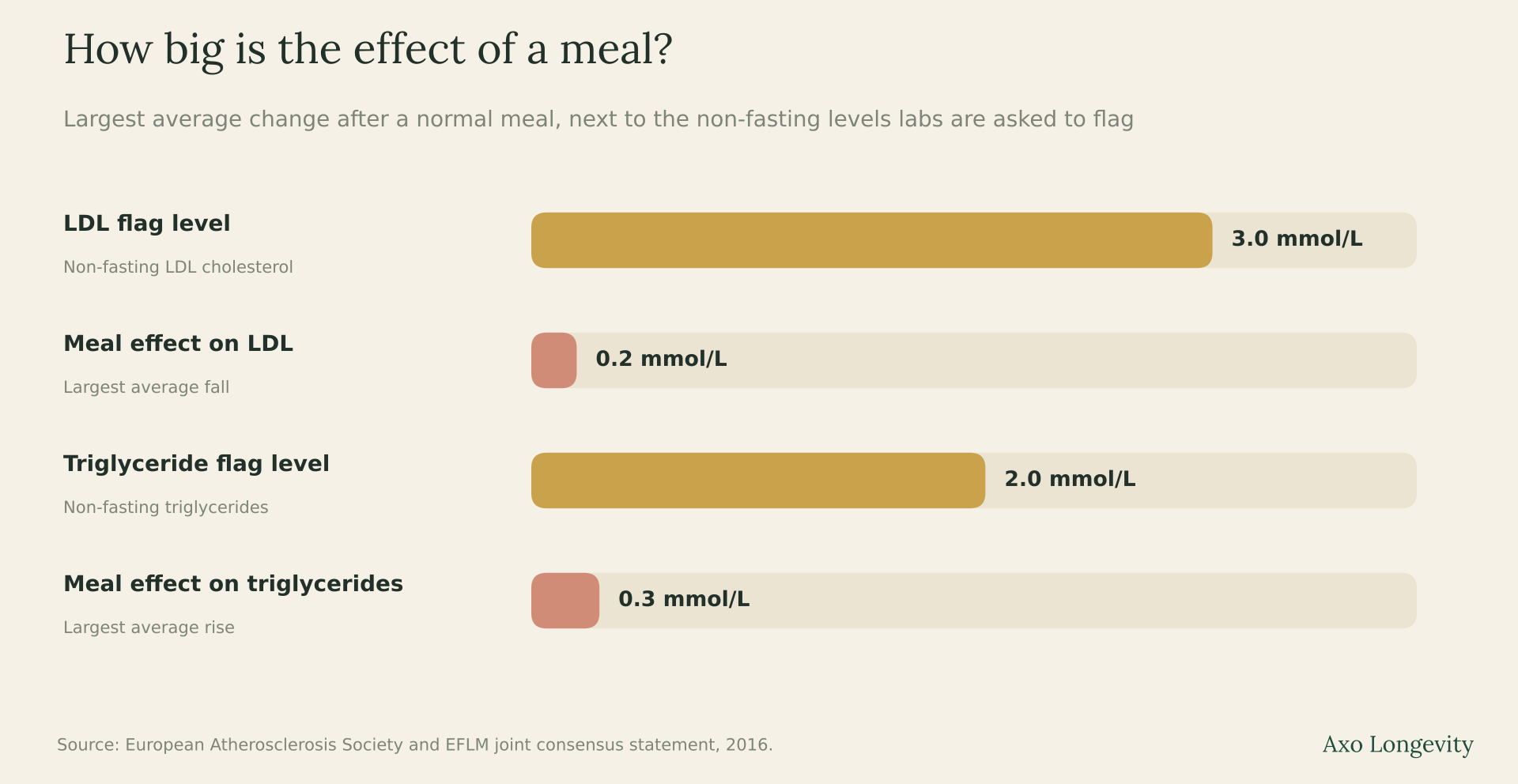
The chart puts the meal effect in context. The largest average change after a meal, 0.2 mmol/L for LDL cholesterol and 0.3 mmol/L for triglycerides, is small next to the levels the same European statement asks labs to flag on a non-fasting test: 3 mmol/L for LDL cholesterol and 2 mmol/L for triglycerides. A meal can still tip a borderline result over a line, which is why a borderline result is worth repeating under the same conditions before you act on it.
How do you prepare so your results can be compared over time?
By keeping the conditions the same every time. A single result is a snapshot. A trend is only real if each snapshot was taken the same way.
In practice:
- check whether your tests need fasting, and follow the longest fast any of them needs
- book a morning appointment, ideally at the same time each time
- drink water as normal, and keep tea and coffee until after the sample
- tell the person taking your sample if you are unwell, or move the test
- write down what you ate and when, if you did not fast
Morning timing helps more than just glucose. Several hormones follow a daily rhythm, as our guide on why cortisol is highest in the morning explains. Your Axo Longevity personalised plan builds on results taken under steady conditions, so the changes you make are judged on real movement rather than on what you had for breakfast.
How do you track your results over time?
By retesting the same lab tests, at the same time of day, with the same preparation. Done that way, a change from one test to the next reflects your body, not your breakfast.
Axo Longevity measures 100+ lab tests across 36+ areas of your health. Around six months later, a follow-up repeats 50+ of those lab tests, so you can see the change for yourself.
→ Your Axo Health Score
→ Results compared to optimal ranges
→ Your personalised plan
→ A follow-up test to track the change
What else do people ask about fasting blood tests?
Can you drink water before a fasting blood test?
Yes. NHS fasting guidance allows water before a fasting blood test. Avoid other drinks unless your lab says they are fine.
Does black coffee break a fast for a blood test?
Yes, for a test that needs fasting. NHS fasting guidance asks people to avoid tea and coffee, including black coffee, on the morning of a fasting test. For tests that do not need fasting, coffee is not a problem.
Can you take your medicines before a fasting blood test?
Usually yes. Keep taking your medicines unless your doctor has told you otherwise. If a medicine needs to be taken with food, or if you have diabetes, ask your doctor what to do before you fast.
Axo Longevity provides health information, not medical advice. Speak to a healthcare professional about your results.
Where does this information come from?
- Nordestgaard, B. G., et al. (2016). Fasting is not routinely required for determination of a lipid profile: a joint consensus statement from the European Atherosclerosis Society and European Federation of Clinical Chemistry and Laboratory Medicine. European Heart Journal, 37(25), 1944–1958. https://doi.org/10.1093/eurheartj/ehw152
- Langsted, A., Freiberg, J. J., & Nordestgaard, B. G. (2008). Fasting and nonfasting lipid levels. Circulation, 118(20), 2047–2056. https://doi.org/10.1161/CIRCULATIONAHA.108.804146
- Wainwright, P., & Davies, C. (2024). Q&A: Lipids part 1, measuring lipids (citing NICE NG238, 2023). Diabetes & Primary Care. https://diabetesonthenet.com/diabetes-primary-care/qa-lipids-part-1-measuring-targets/
- World Health Organization. (2011). Use of glycated haemoglobin (HbA1c) in the diagnosis of diabetes mellitus. https://www.ncbi.nlm.nih.gov/books/NBK304271/
- NHS. Haemoglobin A1c (HbA1c) test. https://www.nhs.uk/tests-and-treatments/haemoglobin-a1c-hba1c-test/
- Nair, R., et al. (2014). Does fasting or postprandial state affect thyroid function testing? Indian Journal of Endocrinology and Metabolism, 18(5), 705–707. https://doi.org/10.4103/2230-8210.139237
- Ridefelt, P., et al. (2010). Influences of sleep and the circadian rhythm on iron-status indices. Clinical Biochemistry, 43(16-17), 1323–1328. https://doi.org/10.1016/j.clinbiochem.2010.08.023
- Jayasena, C. N., et al. (2023). Society for Endocrinology and Association for Clinical Biochemistry joint position statement on male hypogonadism. Annals of Clinical Biochemistry, 60(4), 223–227. https://pmc.ncbi.nlm.nih.gov/articles/PMC10357891
- East Kent Hospitals University NHS Foundation Trust. Fasting for your blood test. https://leaflets.ekhuft.nhs.uk/fasting-for-your-blood-test/html
- The Blood Project. Iron indices: to fast or not to fast? https://www.thebloodproject.com/cases-archive/iron-indices-to-fast-or-not-to-fast/postsrcript-2/
2 ways to get started
It's the best fit if you want an affordable entry point to understand your health baseline.
50+ biomarkers (one round)
Basic biomarker analysis
Biological Age and Axo Longevity Health Score
Cancel anytime
approx.
It's the best fit if you want to track trends over time rather than just see a single moment.
100+ biomarkers annually (two rounds)
Sports science protocols
Personalised health blueprint
Continuous tracking
Biological Age and Axo Longevity Health Score
Cancel anytime
approx.
150+ biomarkers annually (two rounds)
Exclusive 1:1 longevity session with Dr. Niko Mihic or Andy Walshe PhD
GlycanAge testing
Comprehensive genome testing
Annual founding member event
approx.