
We always judge exercise by what we can see or feel: running faster, lifting heavier, lasting longer, and recovering better.
But while you’re tracking the progress on the outside, a lot is changing inside your body too.
Exercise creates a response across the whole body. The heart adapts to repeated demand, while movement supports blood flow and brain function.
Changes in metabolism, circulation and blood pressure also affect how the liver and kidneys function.
These changes do not happen in the same way or at the same speed.
Exercise can also complicate the picture when you test. A demanding session can temporarily alter biomarkers such as creatinine, triglycerides and certain liver enzymes, making an otherwise healthy result look unusual if recent training is ignored.
Understanding exercise properly means looking beyond performance alone and asking a different question: how is each part of your body actually responding to the way you train?
No. Your heart remodels structurally in response to training, changing chamber size and wall thickness. Your brain, kidneys and liver do not restructure in the same way.
They benefit from the conditions regular movement creates: better circulation, improved insulin sensitivity, steadier blood pressure and less fat stored in places it should not be.
That difference matters when you interpret results, because each system leaves a different signature.
Your heart actually gets better at its job when you train regularly.
With endurance exercise, it becomes better at filling with and pumping blood. With strength training, the heart also adapts to the extra pressure created during heavier efforts.
Over time, that can mean more blood pumped with each beat and better cardiovascular fitness.
And these changes can happen sooner than you might think. Research in trained athletes has shown measurable changes in heart structure within just a few months of consistent training.
That matters because cardiovascular fitness is strongly linked with long-term health.
In a study of more than 122,000 adults, people with higher cardiorespiratory fitness had a lower risk of death over the follow-up period, with the fittest group showing the lowest risk.
But there is an important catch.
Being very fit does not automatically mean every cardiovascular result will look ideal.
Take lipoprotein(a), or Lp(a). Your level is largely determined by genetics, which means you can exercise regularly, feel incredibly fit and still have an elevated Lp(a).
Apolipoprotein B, or ApoB, is different. It can be influenced by things like diet, body composition and exercise, but training alone may not always bring it into an optimal range.
That is why your fitness and your blood results tell you different parts of the story.
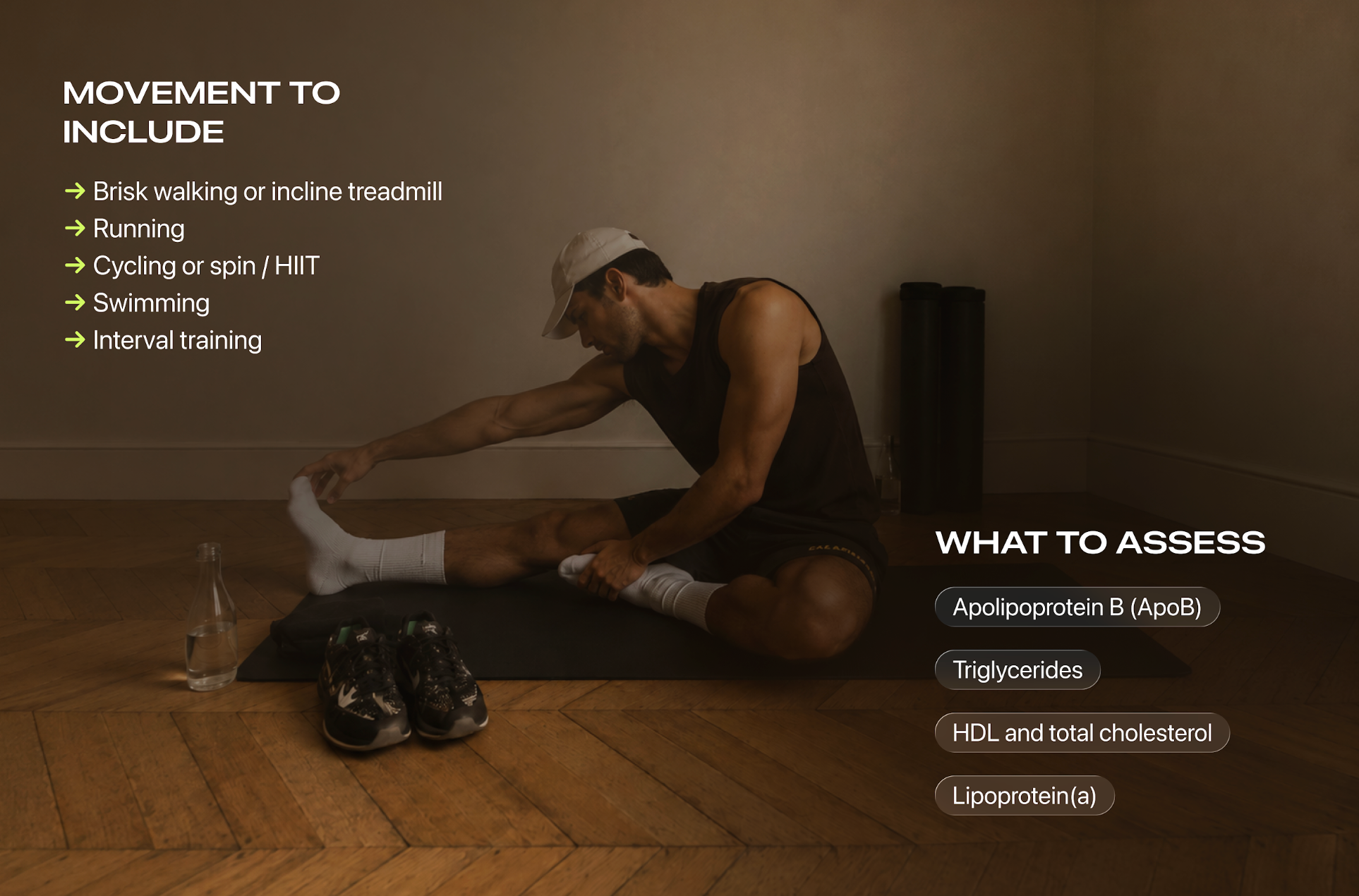
Before you test: trained hard recently? Mention it. A tough session before a blood draw can temporarily shift triglycerides, so your recent training matters when the result is interpreted.
→ Check the cardiovascular risk that training cannot change
Your brain does not train like a muscle. Regular movement supports blood flow to the brain and the way your body handles stress, and the effect builds over months.
The structural evidence is stronger than most people realise. In older adults, a year of regular aerobic exercise increased the size of the hippocampus by around 2%, which is roughly one to two years of age-related decline reversed.
The hippocampus is the part of the brain most involved in memory, and one of the first areas to shrink with age.
Movement is one input among several here. Sleep, daylight, recovery and nutrition all shape how well your brain works day to day, which is why these biomarkers are read together.

Before you test: cortisol follows a daily rhythm, so the time of your draw changes the number. Sleep, stress and recent training all influence the result, which is why a single reading needs context around it.
Your kidneys do not get fitter from training. Regular movement supports your blood pressure, blood glucose and circulation, and those do most of the work in protecting kidney function over the long run.
The testing complication here causes more unnecessary worry than any other on this list.
Creatinine comes from muscle. The more muscle you carry, the more of it you produce, regardless of how well your kidneys are working.
Since eGFR is calculated from creatinine, a well-built person can be placed in a lower kidney function band while their actual filtration is fine.
Creatine supplements have the same effect on the number.
Cystatin C is the way around this. Your body produces it at a steady rate and muscle mass does not affect it, so it works as a cross-check whenever creatinine looks out of step with everything else.

Before you test: muscle mass, recent training, creatine supplementation and diet all sit alongside the result.
Your liver does not get fitter from training. Regular movement creates a healthier environment for it to work in, mainly through better insulin sensitivity and less fat stored in liver tissue.
The insulin sensitivity part fades faster than most people expect. Most of the benefit comes from your recent sessions rather than your accumulated fitness, and it lasts somewhere between 24 and 48 hours.
Monday's session is not still working for you on Friday.
That is an argument for regularity over intensity.
Then there is the testing complication, which is the largest in this article.
ALT and AST are the standard liver biomarkers. Both are also found in muscle.
Heavy resistance training can raise them for a full week even when the liver is completely healthy. In men who were not used to weightlifting, a single session pushed both up, and they were still elevated seven days later.
GGT is the tiebreaker. It does not come from muscle, so it stays in range when training is the cause.
If the picture is still unclear, a week of rest and a repeat test usually settles it.

Before you test: heavy resistance work in the week before your draw can raise ALT and AST. Read alongside GGT and your training log, the picture becomes much clearer.
→ Explore the full Axo Longevity panel
Performance tells you how your body handles load. Testing the right tests tells you how it is responding to everything else.
Axo Longevity measures 100+ lab tests across 36+ health areas, with repeat testing so the effect of your training shows up over time rather than in a single snapshot.
Your membership includes:
→ Axo Longevity Health Score
→ Optimal range interpretation
→ Personalised action plan
→ Repeat testing to track change
This article is for educational purposes only and does not replace medical advice, diagnosis or treatment. Consult a qualified healthcare professional for personalised care.