








Which hormone blood tests should men have in their forties?
November 2, 2026
TL;DR
- For men in their forties, a hormone blood test starts with total testosterone, and adds SHBG and calculated free testosterone because the total alone can mislead.
- In a European study that followed men over 40 for about four years, total testosterone fell by only about 0.1 nmol/L a year, while weight gain pulled it down and weight loss pushed it up.
- 2026 European urology guidance uses 12 nmol/L (about 346 ng/dL) on a morning, fasted test as the threshold for low testosterone in men with symptoms.
- In a study of 3,369 European men aged 40 to 79, only about 2% met the strict definition of age-related low testosterone, so one low reading needs context.
- Test early in the morning, fasted and well, repeat any low result, and compare the same tests over time rather than judging one number.
Somewhere in your forties, testosterone stops being a gym conversation and starts being a health one. Maybe a friend has had his testosterone checked, maybe your energy or sex drive has dipped, or maybe Movember has you thinking about the health checks you keep putting off. Most men who look into it find a confusing mix of home kits and lists of tests to get at 40.
The harder question is which tests are worth having and what the results actually mean. A single testosterone number can look fine when it is not, or look low when it is fine. This guide is for men in their forties who want to know which hormone blood tests to ask for, how the results fit together, why the time of your blood draw matters, and what European research says about low testosterone at this age.
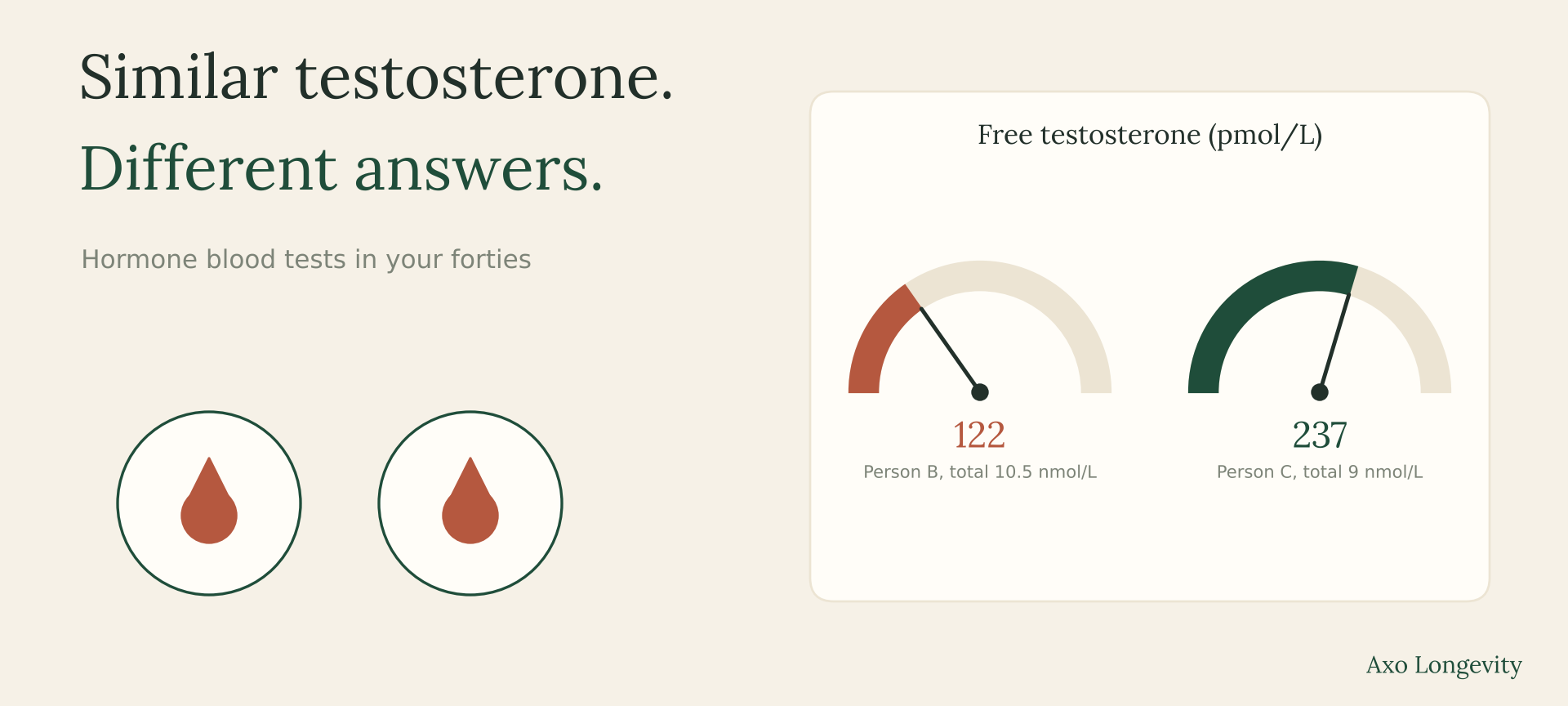
What is a hormone blood test for men?
A hormone blood test for men is a blood sample that measures testosterone and the hormones that carry and control it. The core result is total testosterone. A fuller panel adds SHBG, the protein that carries testosterone in the blood, a calculated free testosterone, and LH, the signal from the brain that tells the testes to make testosterone.
Testosterone is made mainly in the testes, under instructions from the pituitary gland at the base of the brain. When the brain senses that testosterone is low, it sends out more LH to ask for more. That loop is why a good hormone test reads several results together. A low testosterone with a high LH points to the testes struggling to respond, while a low testosterone with a low or normal LH points further up the chain.
Most testosterone in the blood is not free to act. A large share is tightly bound to SHBG, more is loosely attached to albumin, and only a small fraction floats free. That split is the key to reading a male hormone result, and it is where most of the confusion starts.
How is total testosterone different from free testosterone?
Total testosterone is all the testosterone in your blood. Free testosterone is the small part your tissues can use straight away. SHBG decides the split: the more SHBG you have, the more testosterone is locked up, so two men with the same total can have quite different amounts available to their body.
Think of total testosterone as all the money in your name. SHBG is money locked in a fixed-term savings account: it is yours, but you cannot spend it today. Free testosterone is the cash in your current account. Two people can have the same total and very different spending money, depending on how much is tied up.
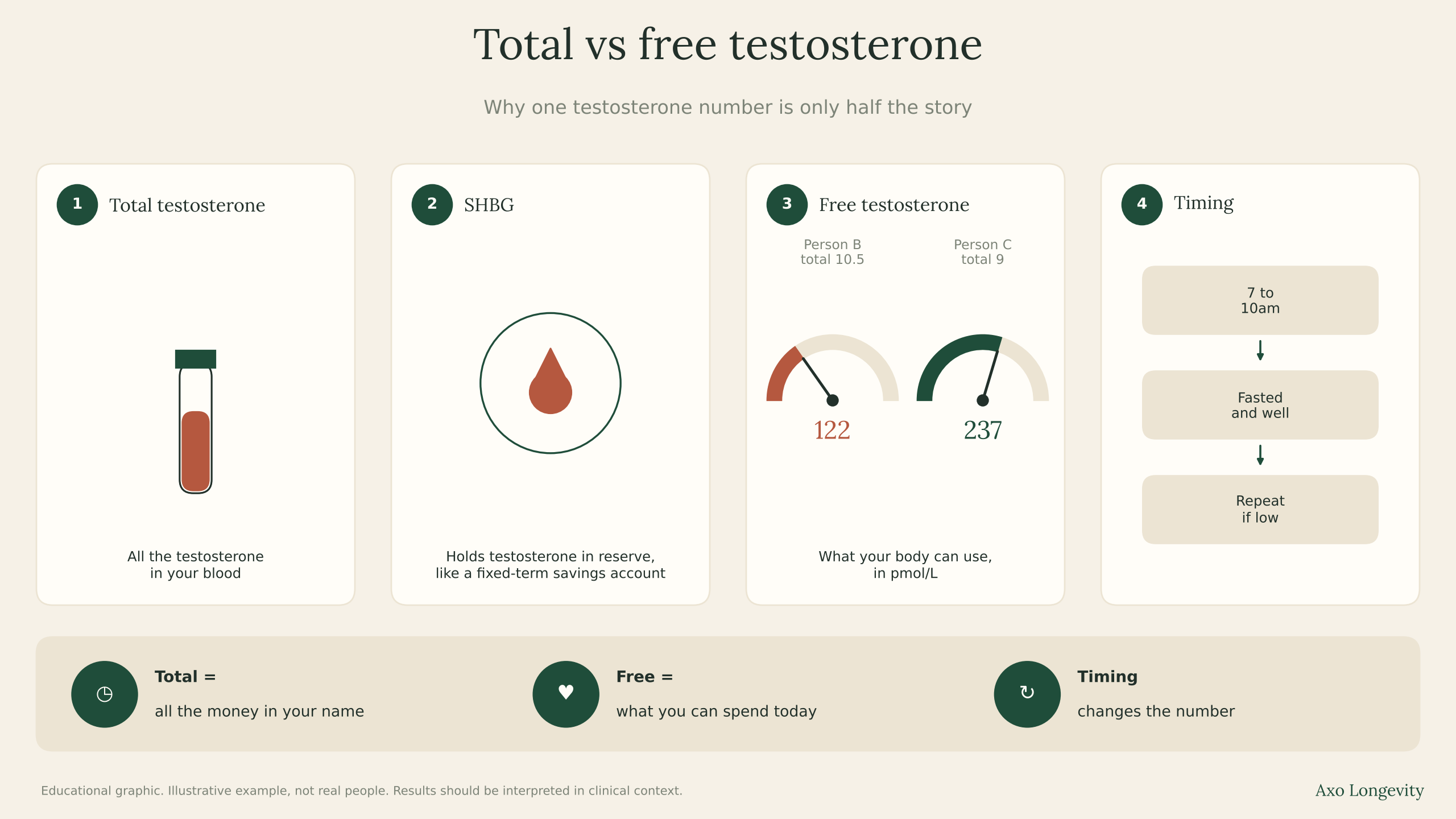
The graphic above walks through the idea. The total is the starting point, SHBG sets how much of it is held in reserve, free testosterone is what is left to work with, and the time of day changes all of it.
Why do hormone levels matter in your forties?
Hormone levels matter in your forties because this is when slow, age-related change meets the effects of weight and health conditions. Testosterone drifts down with age, but the drift is small. The bigger shifts tend to come from things that build up in midlife, and those are the ones you can do something about.
A European study that followed 2,395 men over 40 for about four years found that total testosterone fell by about 0.1 nmol/L a year on average, while SHBG rose slightly, so free testosterone fell a little faster. Men who gained weight saw their testosterone fall, and men who lost weight saw it rise.
The same group of men had shown how big the weight effect is. In the first round of the study, covering 3,200 men aged 40 to 79 in eight European countries, men with a BMI of 30 or more had total testosterone 5.09 nmol/L lower than men with a BMI under 25, and long-term health conditions lowered it by 0.80 nmol/L.
That is the case for looking at more than one number. Axo Longevity compares results to optimal ranges as well as standard ranges, because a result inside the lab's range can still be drifting in the wrong direction for you.
Should men over 40 check their hormones if they feel fine?
Routine health checks in Europe do not usually include hormones, so a baseline in your forties is the only way to see your own trend later. Germany's Gesundheits-Check-up, offered every three years from 35, and England's NHS Health Check, offered every five years from 40, both look at blood pressure and cholesterol, and often blood sugar, but not testosterone.
It is fair to be clear about what the guidance says. European and UK specialist guidance on low testosterone is written for men with symptoms, and a single result in a man who feels well is easy to over-read. What a baseline gives you is a reference point. If your energy, sex drive or recovery changes at 47, a result from 42, taken the same way, tells you far more than a lab range built from thousands of other men.
Which hormone blood tests should men in their forties ask for?
Five results answer most of the questions men in their forties have: total testosterone, SHBG, calculated free testosterone, LH and DHEA-S. Each one answers a different question, and they make most sense read together.
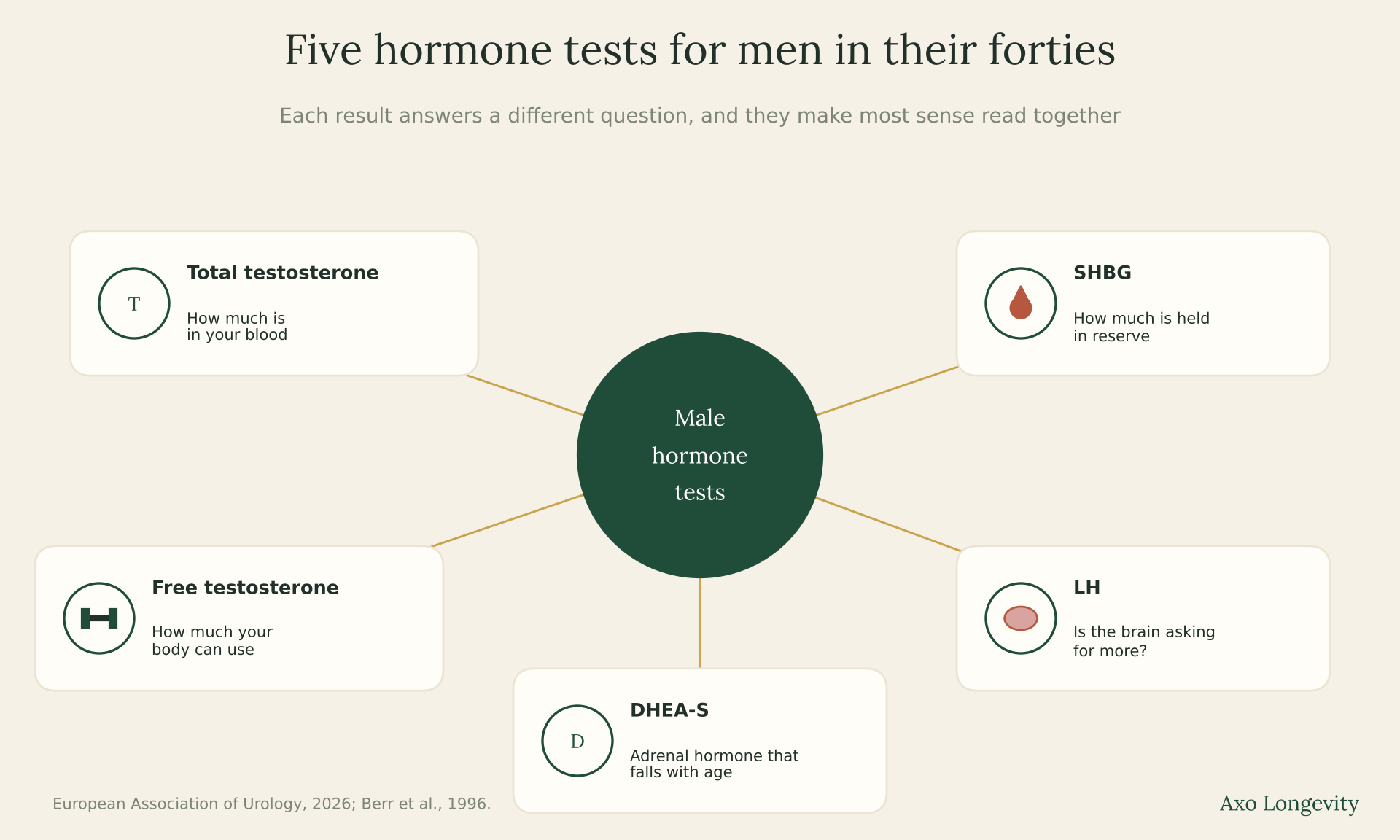
As the graphic shows, they work as a set:
- Total testosterone: how much testosterone is in your blood. The first test, and often the only one needed when the result is clearly high or clearly low.
- SHBG: how much of that testosterone is held in reserve. 2026 European urology guidance supports measuring it more widely, because it helps prevent a wrong reading of total testosterone.
- Calculated free testosterone: the share your tissues can use, worked out from total testosterone, SHBG and albumin. Direct free testosterone tests other than the specialist reference method tend to be inaccurate, so calculated is usually the better choice.
- LH: whether the brain is asking for more testosterone. It helps explain why a level is low.
- DHEA-S: a hormone made by the adrenal glands. Levels peak in your twenties and fall to about 10 to 20% of young adult levels by your seventies and eighties, so it is most useful tracked over time.
Why can two 44-year-old men with similar testosterone get different answers?
Because SHBG and the time of the blood draw change what the same number means. A total testosterone result is only half the story until you know how much of it is free.
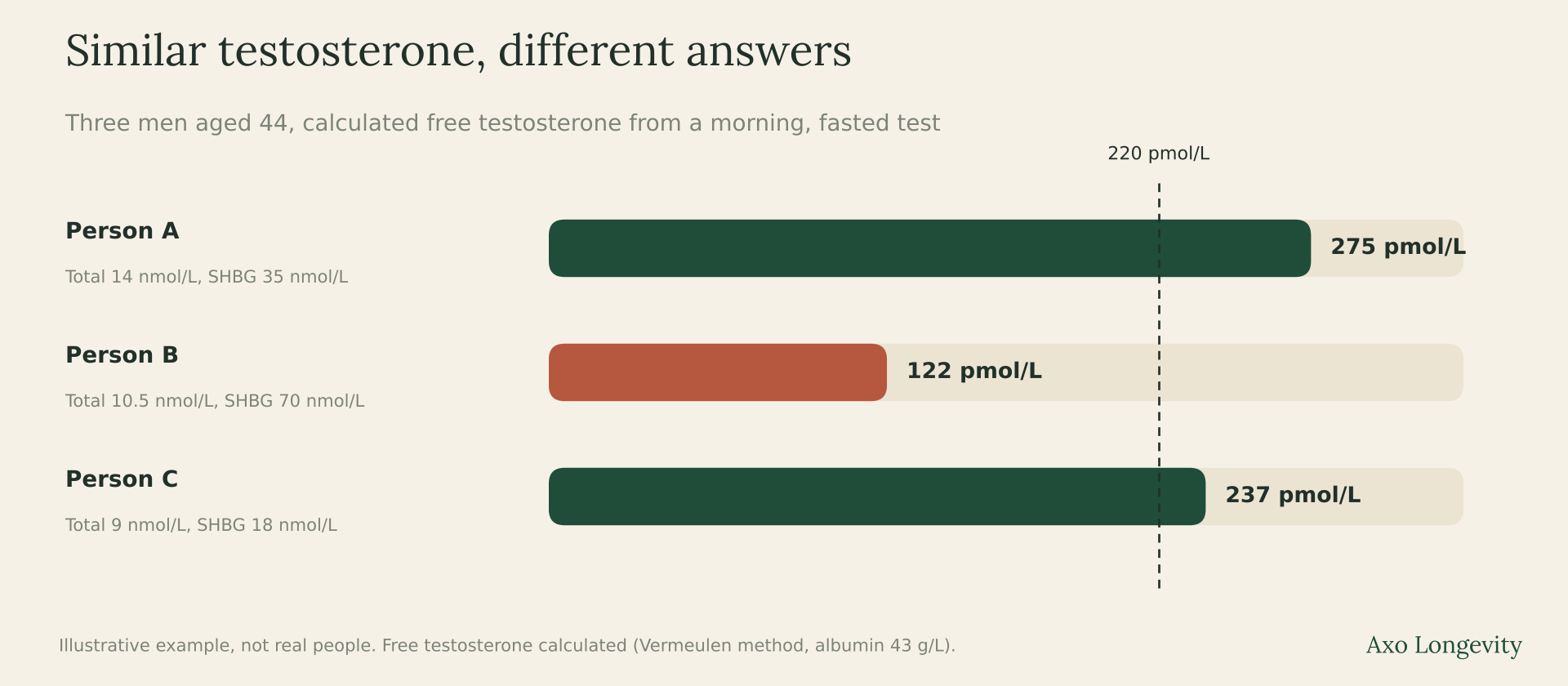
Take three men who are all 44 (an illustrative example, not real people), each tested at 8am after fasting. Person A has a total testosterone of 14 nmol/L and an SHBG of 35 nmol/L, which gives a calculated free testosterone of about 275 pmol/L. Comfortably fine on both counts.
Person B has a total of 10.5 nmol/L, just under the European threshold, and his SHBG is 70 nmol/L, twice Person A's. More of his testosterone is locked up, and his free testosterone comes out at about 122 pmol/L, well below the 220 pmol/L (about 64 pg/mL) used to define low free testosterone in the large European study. Person C has an even lower total of 9 nmol/L, which looks more worrying at first glance. But his SHBG is only 18 nmol/L, so his free testosterone is about 237 pmol/L, higher than Person B's.
The chart shows the twist: the man with the lowest total has more usable testosterone than the man in the middle. SHBG tends to run higher in smokers, and 2026 European guidance supports measuring it more widely. Had Person C been tested at 4pm after lunch, his total would likely have read lower still, and the result could not have been used at all.
Before you test: book an early appointment and have your blood taken between 7 and 10am, fasted and after a good night's sleep. Move the test if you are unwell, and if a result comes back low, repeat it the same way before reading anything into it. Keep to the same routine every time you test with Axo Longevity, so each result can be compared with the last.
What is a normal testosterone level for a man in his forties?
There is no single normal level, because labs across Europe set different reference ranges and some report testosterone in different units. 2026 guidance from the European Association of Urology uses a total testosterone of 12 nmol/L or less, on a morning, fasted test, as the threshold for low testosterone in men with symptoms.
Many labs in continental Europe report testosterone in ng/dL or ng/mL instead of nmol/L. To convert, multiply nmol/L by 28.8 for ng/dL, so 12 nmol/L is about 346 ng/dL, or 3.5 ng/mL.
Some countries add more detail. In the UK, 2023 guidance from the Society for Endocrinology splits the range into three bands, and notes that UK labs set the bottom of their own range anywhere from 4.9 to 11 nmol/L.
Both sets of guidance agree on the conditions. Results taken after eating, during an illness or late in the day cannot be used to confirm low testosterone, because testosterone is higher in the morning and falls through the day, drops after meals and with poor sleep, and varies a lot from one day to the next.
What did the big European study of men over 40 find?
The largest study of this question found that age-related low testosterone was uncommon, and that it showed up mainly as three sexual symptoms. Researchers tested 3,369 men aged 40 to 79 at eight European centres and asked about 32 possible symptoms. They found:
- three sexual symptoms were most closely linked to low testosterone: fewer morning erections, fewer sexual thoughts and erectile problems
- physical symptoms such as low energy for vigorous activity, and mood symptoms such as sadness and fatigue, were only weakly linked
- the researchers defined late-onset hypogonadism as all three sexual symptoms plus a total testosterone below 11 nmol/L and a free testosterone below 220 pmol/L
- about 2% of men met that strict definition
In plain words, a true age-related testosterone problem is uncommon, and tiredness or low mood on their own are poor clues to it.
How worried should you be about a low result?
One low result confirms nothing on its own. Testosterone moves with the time of day, food, sleep and illness, so a single reading below the range needs repeating before it means anything. Even a confirmed low result is often explained by weight, sleep or a health condition rather than an age-related hormone problem.
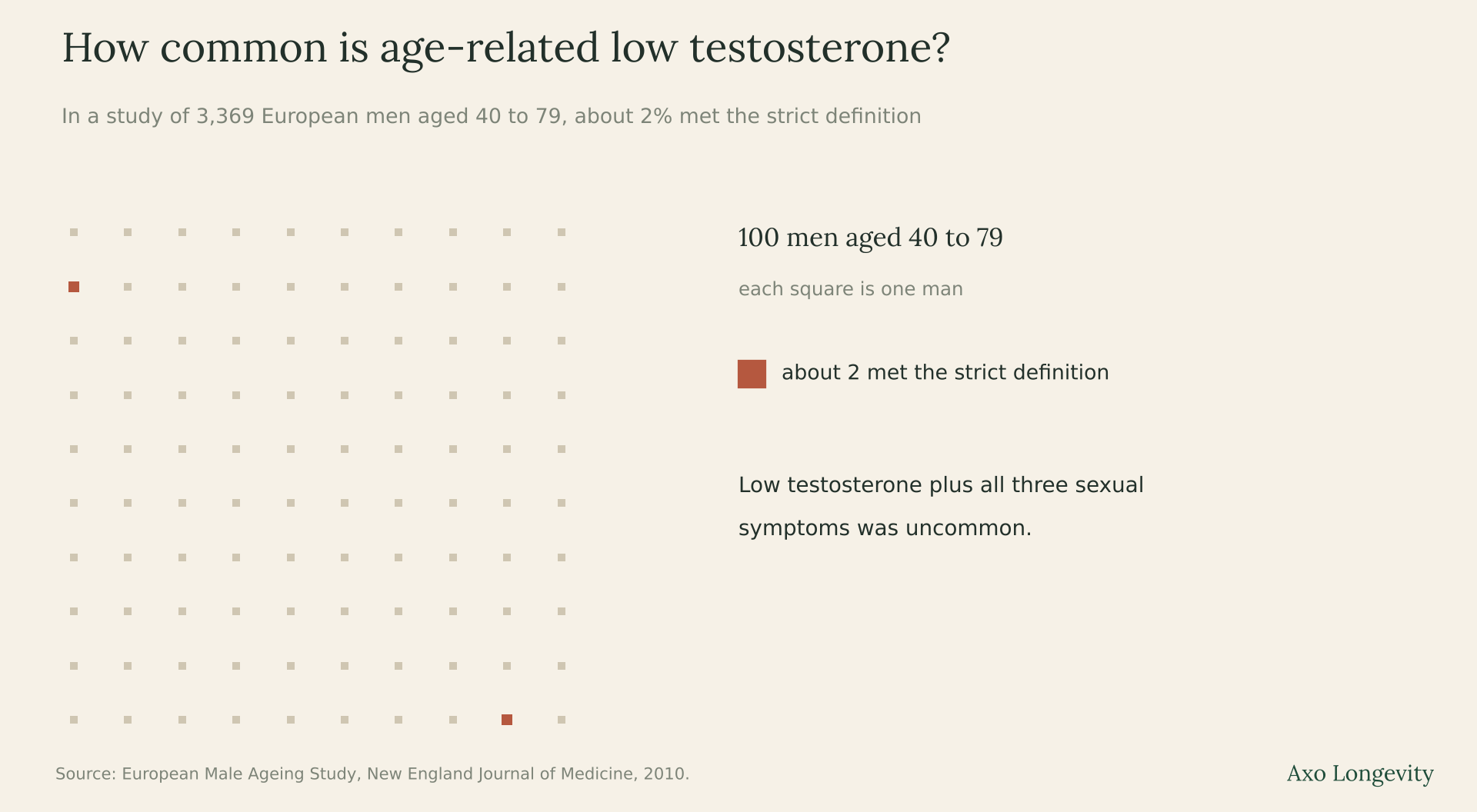
The grid puts the European study in proportion: about 2 men in every 100 aged 40 to 79 met the strict definition. The UK's NHS makes a similar point, noting that in many cases the symptoms men put down to hormones come instead from stress, low mood, poor sleep, alcohol or inactivity.
See a doctor if any of these apply, whatever your age:
- a lasting drop in sex drive together with fewer morning erections
- erection problems that do not go away, which can also come from heart problems or smoking
- two morning, fasted testosterone results at or below 12 nmol/L, together with symptoms
What else has research found about testosterone and long-term health?
Very low testosterone is linked with a shorter life, and the levels involved sit at the very bottom of the range. In an analysis of 11 studies including 24,109 men, published in 2024, men with total testosterone below 7.4 nmol/L (213 ng/dL) had a higher risk of dying from any cause, and men below 5.3 nmol/L (153 ng/dL) had a higher risk of dying from heart and circulation disease.
Two points keep this in proportion. These are very low levels, well under the 12 nmol/L European threshold. And the study shows a link, not a cause: low testosterone may be a sign of poor health as much as a driver of it. The same analysis found that an LH above 10 IU/L was also linked with higher risk, another reason to read testosterone alongside the hormones that control it.
Can you raise your testosterone naturally?
For many men in their forties, yes, because weight is the biggest modifiable factor in the research. In the European study, men with a BMI of 30 or more had testosterone more than 5 nmol/L lower than lean men, far more than years of ageing produce, and men who lost weight over the follow-up saw their testosterone rise.
In practice:
- work towards a healthy weight, which in the research makes the largest difference
- keep regular, sufficient sleep, especially in the days before a test
- manage long-term conditions such as type 2 diabetes with your doctor
- retest the same way after a few months of change
What the research cannot promise is how much any one man's testosterone will rise, or that a higher number will fix symptoms that may have other causes. Your Axo Longevity personalised plan starts from the results that are furthest from optimal for you, so the changes you make target what is actually holding you back.
→ Read the signs that a low testosterone result may need a closer look
How do you track your hormones over time?
By repeating the same tests, at the same time of day, under the same conditions. A morning, fasted result compared with another morning, fasted result shows real change; a morning result compared with an afternoon one mostly shows the clock. Our guide to hormone imbalance in men covers the symptoms that are worth tracking alongside the numbers.
Axo Longevity measures 100+ lab tests across 36+ areas of your health. Around six months later, a follow-up repeats 50+ of those lab tests, so you can see how your results have changed. Availability varies by country.
→ Your Axo Health Score
→ Results compared to optimal ranges
→ Your personalised plan
→ A follow-up test to track the change
What else do people ask about hormone blood tests for men?
What tests should a man have at 40?
Routine health checks in Europe, such as Germany's check-up from 35 or England's NHS Health Check from 40, cover blood pressure and cholesterol, and often blood sugar. Testosterone is not part of them, so men who want a hormone baseline need to ask for it or arrange it separately.
Can a blood test detect a hormone imbalance?
Yes, for the hormones it measures. A morning, fasted blood test can show whether testosterone is low, and SHBG, free testosterone and LH help explain why. One result is not enough: a low reading needs repeating.
What will a hormone blood test show?
A male hormone blood test shows your total testosterone and, depending on the panel, SHBG, calculated free testosterone, LH and DHEA-S. Together they show how much testosterone you make, how much your body can use and whether the brain is asking for more.
Axo Longevity provides health information, not medical advice. Speak to a healthcare professional about your results.
Where does this information come from?
- Corona, G., et al. (2026). EAU Guidelines on Sexual and Reproductive Health: a summary of the 2026 recommendations for measurement and biochemical confirmation of hypogonadism. European Urology Focus. https://doi.org/10.1016/j.euf.2026.04.015
- Camacho, E. M., et al. (2013). Age-associated changes in hypothalamic-pituitary-testicular function in middle-aged and older men are modified by weight change and lifestyle factors: longitudinal results from the European Male Ageing Study. European Journal of Endocrinology, 168(3), 445–455. https://doi.org/10.1530/EJE-12-0890
- Wu, F. C. W., et al. (2008). Hypothalamic-pituitary-testicular axis disruptions in older men are differentially linked to age and modifiable risk factors: the European Male Aging Study. Journal of Clinical Endocrinology & Metabolism, 93(7), 2737–2745. https://academic.oup.com/jcem/article/93/7/2737/2598963
- Wu, F. C. W., et al. (2010). Identification of late-onset hypogonadism in middle-aged and elderly men. New England Journal of Medicine, 363(2), 123–135. https://doi.org/10.1056/NEJMoa0911101
- University of Manchester. (2010, June 17). Researchers unzip symptoms of the male menopause. https://www.manchester.ac.uk/about/news/researchers-unzip-symptoms-of-the-male-menopause/
- Yeap, B. B., et al. (2024). Associations of testosterone and related hormones with all-cause and cardiovascular mortality and incident cardiovascular disease in men: individual participant data meta-analyses. Annals of Internal Medicine, 177(6), 768–781. https://doi.org/10.7326/M23-2781
- Jayasena, C. N., et al. (2023). Standardising the biochemical confirmation of adult male hypogonadism: a joint position statement by the Society for Endocrinology and Association of Clinical Biochemistry and Laboratory Medicine. Annals of Clinical Biochemistry, 60(4), 223–227. https://doi.org/10.1177/00045632231179022
- Berr, C., et al. (1996). Relationships of dehydroepiandrosterone sulfate in the elderly with functional, psychological, and mental status, and short-term mortality. PNAS, 93(23), 13410–13415. https://doi.org/10.1073/pnas.93.23.13410
- Vermeulen, A., Verdonck, L., & Kaufman, J. M. (1999). A critical evaluation of simple methods for the estimation of free testosterone in serum. Journal of Clinical Endocrinology & Metabolism, 84(10), 3666–3672. https://doi.org/10.1210/jcem.84.10.6079
- Federal Ministry of Health, Germany. Gesundheits-Check-up. https://www.bundesgesundheitsministerium.de/checkup.html
- NHS England. NHS Health Check. https://www.nhs.uk/service-search/other-health-services/nhs-health-check
- NHS. The "male menopause". https://www.nhs.uk/conditions/male-menopause/
2 ways to get started
It's the best fit if you want an affordable entry point to understand your health baseline.
50+ biomarkers (one round)
Basic biomarker analysis
Biological Age and Axo Longevity Health Score
Cancel anytime
approx.
It's the best fit if you want to track trends over time rather than just see a single moment.
100+ biomarkers annually (two rounds)
Sports science protocols
Personalised health blueprint
Continuous tracking
Biological Age and Axo Longevity Health Score
Cancel anytime
approx.
150+ biomarkers annually (two rounds)
Exclusive 1:1 longevity session with Dr. Niko Mihic or Andy Walshe PhD
GlycanAge testing
Comprehensive genome testing
Annual founding member event
approx.